




Nox Library
December 13, 2025
Local oligarchs soak up hundreds of millions in public subsidies, capturing tax revenue and funds meant for schools, libraries, and public infrastructure. Occasionally, in between campaign contributions, they donate a small portion of their money to support the arts or a public good. These contributions are of course tax deductible, and never balance out the funds they have stripped out of our communities. We are expected to be grateful for our supposed Shepherds, to cheer the latest “little” gilbertville, and to forget where the money came from. As artist and community members we believe there is a better way – rather than giving our public wealth over the rich in exchange for crumbs – we imagine a world without oligarchs; where we fund our neighbors, our culture, and our future, and where our society is run in the interests of the many, rather than the whims of the few.
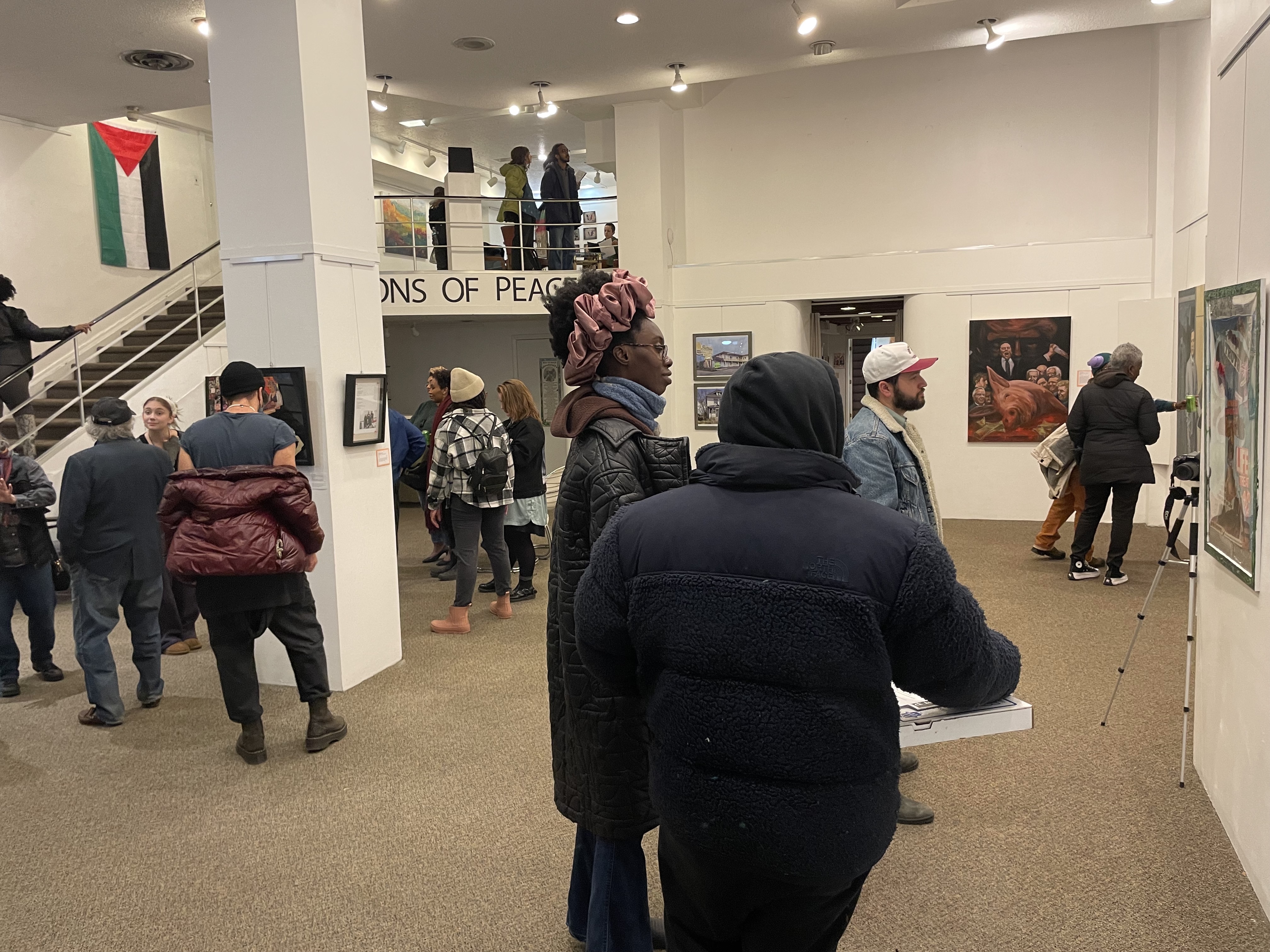
The above statement is the outline for the exhibition, Detroit 2050: A Future Beyond Billionaires, that is up at Swords into Plowshares Peace Center and Gallery until December 20, 2025.
This exhibition is the first time I’ve witnessed a public calling out of the woven networks between the art community and the billionaires’ strong hold on Detroit. There is so much to disentangle between these networks that one exhibition, public event, or writing cannot possibly cover all of the facets of the ever morphing and expanding web of art washing in the city. This writing does not attempt to do so either, but what is covered in the following essay is an overview of how Detroit caters to billionaires through tax incentives, how artists have approached highlighting the impact of these policies, and the legacy, purpose, and need for spaces like Swords into Plowshares (SIP) to host such exhibitions.
This juried exhibition—co-organized by gallery volunteers and representatives from Riverwise Magazine, Detroit Action, Party for Socialism and Liberation, Detroiters for Tax Justice, and Talking Dolls—features 27 artists that work in a range of mediums from writing, painting, sculpture, fiber, charcoal, prints, collages and many others. The open call asked artists to submit two pieces: one that responds to the show’s focus and another that is representative of their creative practice.
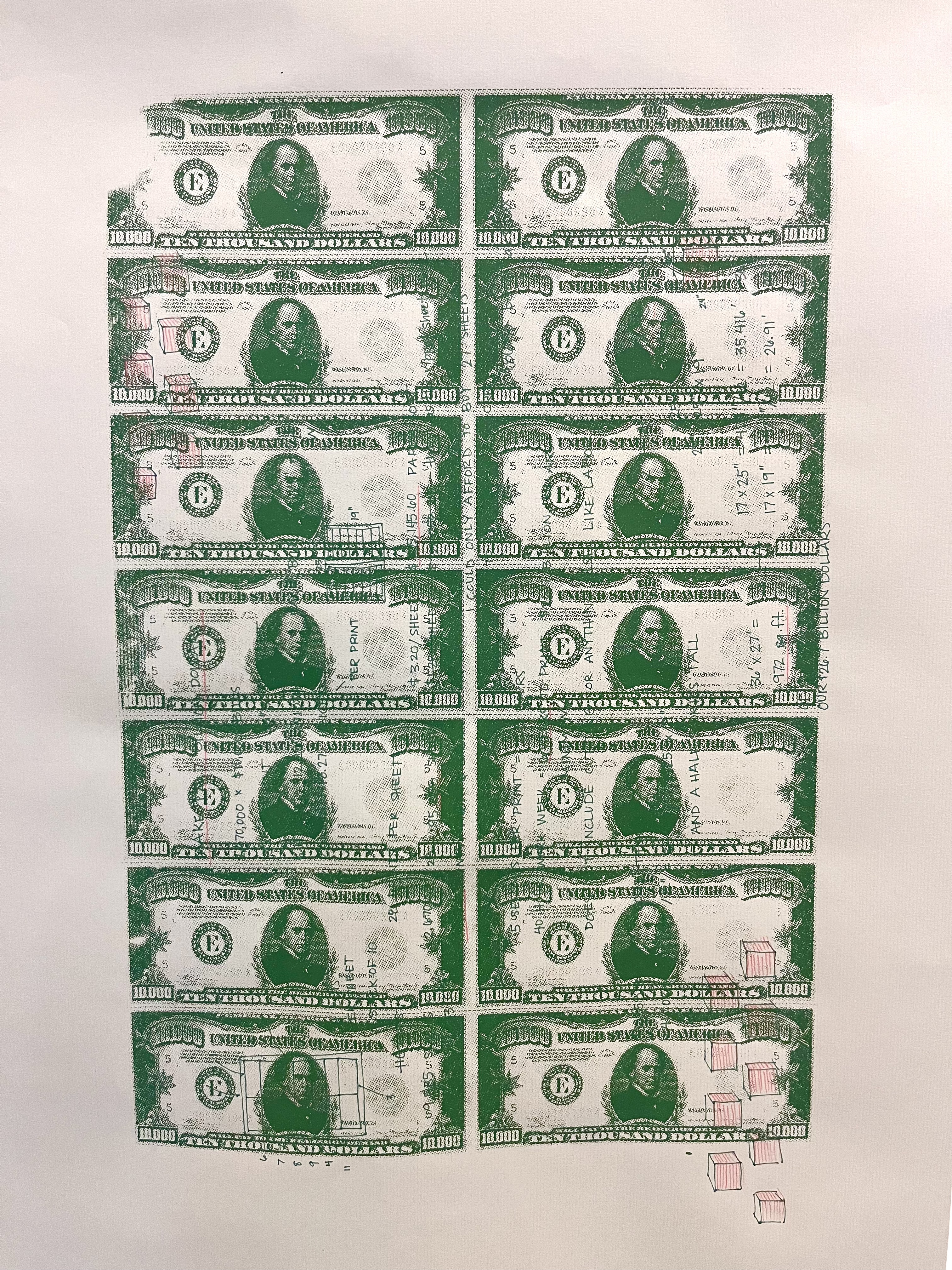
The opening on November 13th featured a live screen printing performance by Andrea Cardinal, who was producing $10,000 bills. Entitled 26 Billion Dollars, this piece is a response to Dan Gilbert’s net worth as of October 2025. The description of the work states, “Dan Gilbert is worth 26 Billion dollars. What would that look like, in stacks of $100 bills? of $1,000 bills? of $10,000 bills? How long would it take to print $26 billion dollars in $10,000 bills? What would it look like if we made a team of people design, print, cut, and distribute $10,000 bills? What would you do with just one of these bills?” Alongside the burned out screens was a handwritten poster that attempted to break down the logistics of printing $26 billion dollars. One of the most striking points outlined was that if enough $10,000 bills were printed to make up the $26 billion dollars and then they were stacked one on top of the other, the stack would be three stories tall. How does one grapple with the sheer numbers that are outlined? How does someone amass such wealth in a city where the citizens have struggled decade after decade? It is clear that the only way someone would make anywhere near a billion dollars is from the exploitation of others. In Detroit, that exploitation does not only come from the labor of employees working, but also through tax incentives, tax captures, tax abatements and the Detroit Economic Growth Corporation (DEGC). This is not mere speculation, thanks to years of grassroots organizing and research, Detroiters for Tax Justice has exposed the details of these occurrences.
In 2022, Detroiters for Tax Justice (DFTJ) began their research of how much tax money was moving into private for-profit entities in Detroit and in the summer of 2024 they released their “Billion Dollar Report.” With information collected under a Freedom of Information Act (FOIA) filed by DFTJ, this report shows that under Mayor Mike Dugan over a billion dollars were tax captured and tax abated under the guise of the DEGC between 2014-2023 and funneled into private hands.
There are two key tools that benefit billionaires—tax captures and tax abatements. Tax captures redirect a portion of tax generated revenue towards “revitalization” efforts and tax abatements allow developers to not pay taxes on a project. In 1975, tax captures became law in Michigan (PA 197) to “correct and prevent deterioration of downtown areas in the state of Michigan.” A tax capture allows for the mayor of a city to siphon off tax revenue from the general funds and give that money to “revitalization” efforts or into developers’ hands for projects in the city. Under the same law, the legal framework for Detroit Downtown Authorities (DDAs) was created. Per the DFTJ website, “In Detroit, our DDA exists under the broader umbrella of the ‘Detroit Economic Growth Corporation,’ or DEGC. The DEGC is a quasi-governmental entity overseeing other various development ‘authorities’ that have the ability to take tax captures from our local millages. The members of these authorities are appointed by the mayor, they are not subject to public oversight, and all of them are insiders from the local business elite.” The DEGC can move money from taxes that were voter approved, and move it to a different project without legally requiring a public vote.
This transfer of funds impacts public spaces such as the libraries, schools, and parks. For example, the Billion Dollar Report shows that between 2014 and 2023 over $53.9 million dollars were redirected from the Detroit Public Library, $205.6 million was siphoned from the Detroit Public Schools Community District (DPSCD), $237.1 million taken from the city general fund (covers busses, parks, recreation centers, payroll for city workers, etc.), and this is just to give a few examples. On top of tax captures, tax abatements are when a city gives investors or developers permission to not pay property taxes on a proposed project for up to 35 years. This means that they do not pay their own taxes and contribute to taxpayer-funded public services. In short, billionaires become billionaires not just by exploiting our labor and communities, but by using their political control to steal millions, if not billions of dollars away from our city, and thus the people of Detroit.
What does this have to do with art spaces? Why should artists be concerned with this redistribution of public funds into private hands? We can find the answer at the bottom of any event poster, exhibition citation, and the last page of a catalogue that has a list of sponsors—such as the Gilbert Family Foundation or Bedrock. The very people that have benefited from cozying up to Mayor Duggan for favors by means of captures and abatements, are those that fuel the mainstream artist events and economy in Detroit—the newly announced Lumana Art Foundation comes to mind. The control of art and culture is an essential strategy of the Billionaire class for building up capitalism and upholding its narrative, and Detroit is not exempt from this undertaking. Often, this sort of elite cultural control is portrayed as a necessary or inevitable evil; but if artists are to play a role in seeing and shaping our world, couldn’t some of this energy go toward imagining a better way to support art and cultural work in the city.
The exhibition at SIP has a hopeful forward looking title, “Detroit 2050,” with a bit of a jab, “A Future Beyond Billionaires,” nodding at the fact that we do not have to concede, that artists can be visionaries and use their skills to envision and work towards a better world. This idea is the very foundation on which Swords into Plowshares Peace Center and Gallery was founded. On June 13, 1986, Rev. James Bristah, members of the Central United Methodist Church, and community activists came together with a mission. In Bristah’s words, “Art and peace are handmaidens, if there is to be peace, people, including politicians, are going to have to take creative initiatives. That is what every artist does. And that is the task for every person.” SIP has kept this focus throughout its 40 years as a gallery. Their first exhibition The Ribbons, on June 13, 1986, commemorated the 40th anniversary of the atomic bombings on Japan, and was followed by exhibitions that spoke out against the atrocities in Vietnam, the invasion of Iraq, and the current genocide in Gaza. As a volunteer-run non-profit independent organization, SIP receives a rent free agreement from the Central United Methodist Church, but has largely operated under public donations. The gallery has remained in Grand Circus Park for over four decades, and in recent years, it has become a prick in the side of the growing DDA and shiny businesses that cater to the wealthy who would rather not think about local or global injustices and instead, would very much prefer that the space be used for different intentions. So when Detroit 2050: A Future Beyond Billionaires opened and a projection popped up on the window of looming eyes and text that rhythmically reads “Dan Gilbert is watching,” it is clear that they, too, are also watching.
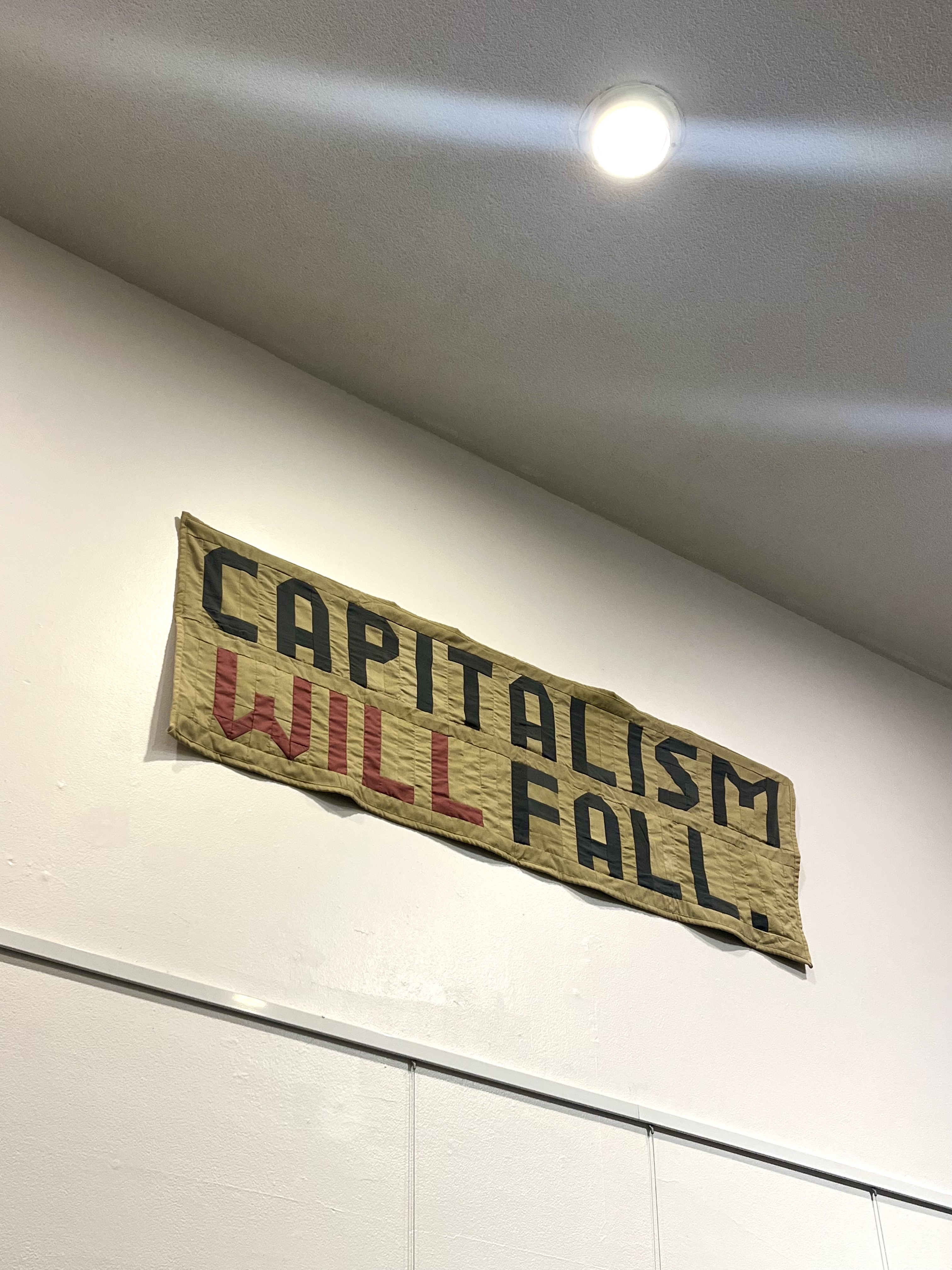
At Nox Library, our core question is, What is art’s role in making a better world possible? This question is impossible to answer alone—it is only through many voices and collectivism that any sort of movement towards a better world can happen. To emphasize this point I will leave you with an artwork by Victoria Marcetti titled “Capitalism.” This piece is featured in Detroit 2050: A Future Beyond Billioniares, and consists of two quilted horizontal banners that are made from thrifted surplus t-shirts dyed with home grown marigolds. The banners state “CAPITALISM MUST FALL” and “CAPITALISM WILL FALL”. Accompanying these works is a statement that poignantly outlines, “Ursula K. Le Guin wrote: ‘We live in capitalism, its power seems inescapable - but then, so did the divine right of kings. Any human power can be resisted and changed by human beings. Resistance and change often begin in art. Very often in our art, the art of words.’ The end of capitalism is not only an imperative, but an inevitability. To save each other, we must build something different. We can, and we will.”
- Nox Library
References:
Detroiters for Tax Justice. n.d. Accessed December 9, 2025. https://detroitersfortaxjustice.com
Additional information:
Before the closing on December 20 there will be two panel discussions in line with the exhibition focus. The first panel on December 11 covered the effects that extreme wealth has on public social institutions and the impacts it undermines for collective democratic processes. The second panel on December 19 brings out the connection between billionaires and their impact on philanthropic art ventures in Detroit.