




Amina Cattaui
July 13, 2026
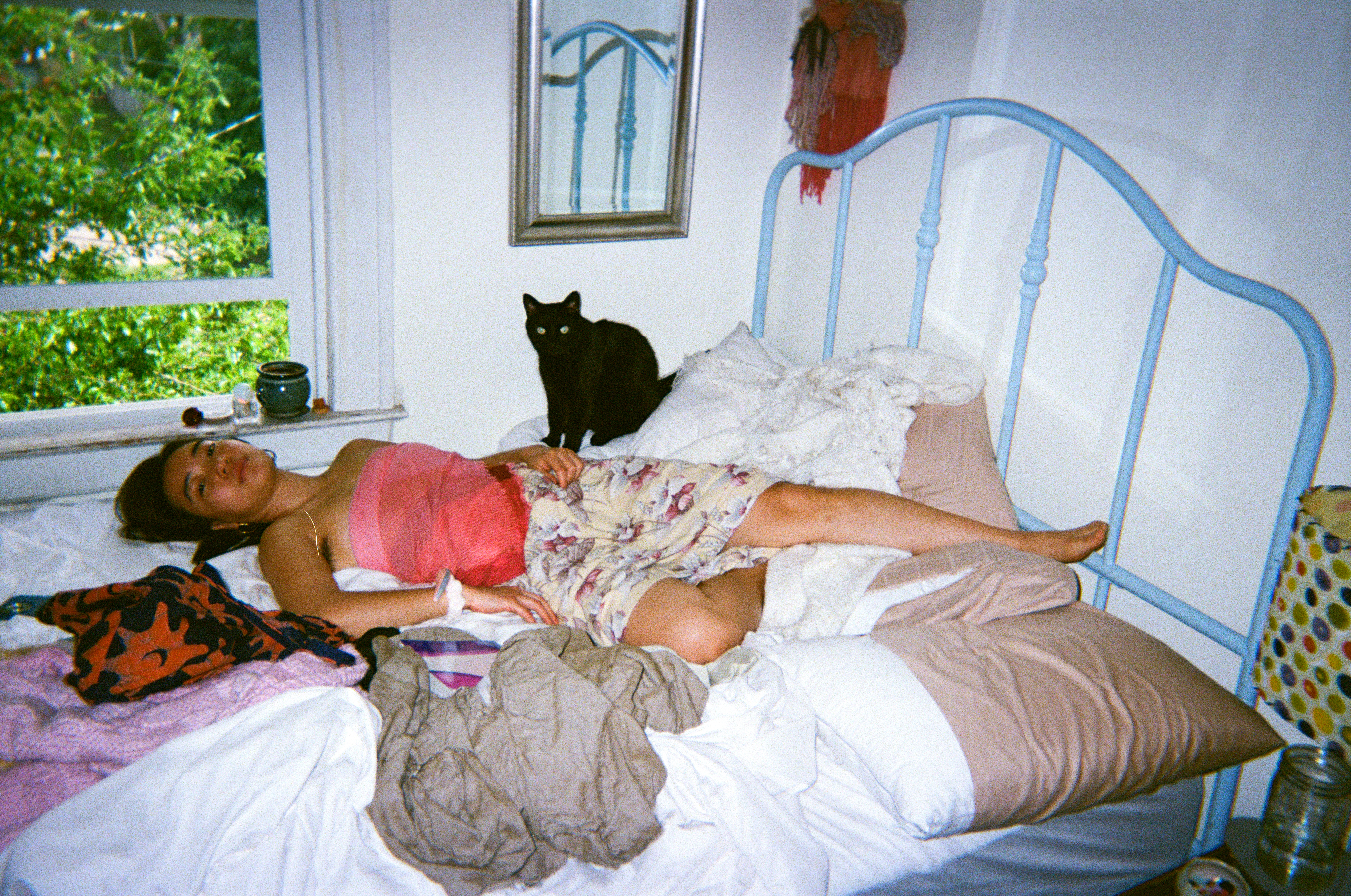
The artist lounges in a bed at a Sleep Piece #1 participant’s house.
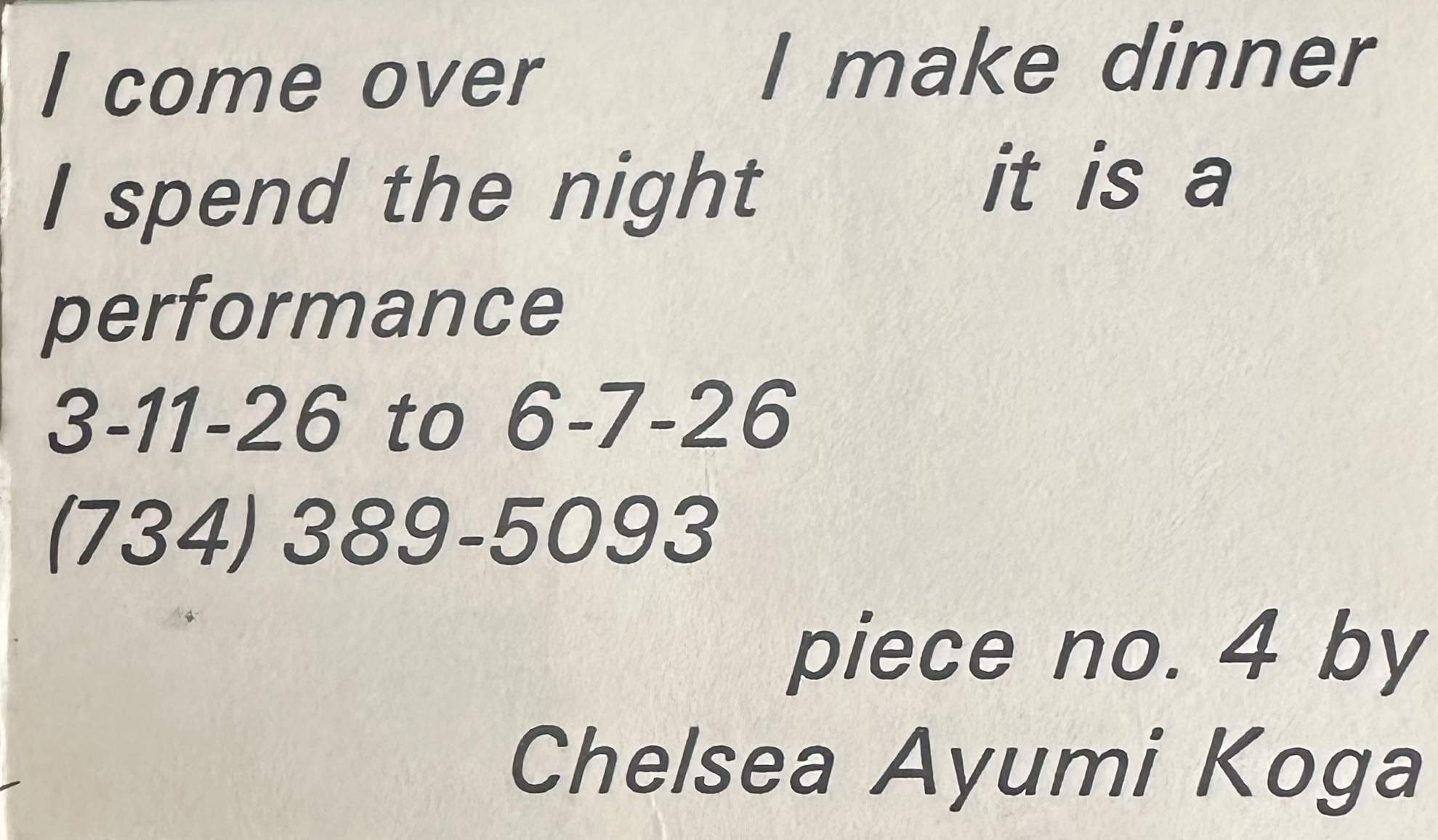
An invitation to Sleep Piece #1, (2026).
When I still lived in Michigan I found a business card on my dining room table. It was an invitation to a happening: I come over. I make dinner. I spend the night. It is a performance. This was my introduction to the work of Chelsea Ayumi Koga, the “durational performance” artist based in Detroit. Her performances, which play on the vulnerability of intimacy, are tantamount to public stunts: For a piece, she’s locked herself in a studio for two weeks and invited onlookers to come chat with her. Where at least Koga controlled the studio-space of My New House (2025), this year’s Sleep Piece #1 is her riskiest yet, subjecting herself to the whims of the strangers that accept her dinner invitation. For Koga, vulnerability is an artistic challenge and a civic duty: to create moments of radical human connection at a time when ‘stranger danger’ has conditioned us to expect torment.
In a world that’s stopped knowing its neighbors, Sleep Piece #1 (2026) reminds us that we practice the possible into the real. In Koga’s world real love is possible. You just have to let it in.
At the conclusion of Sleep Piece #1 (2026) in June, I sat down with Koga to talk about performance art as praxis, the influence of her time in customer service, and the meaning of the word “stranger.”
Amina Cattaui: I came across your work by way of a business card left on my table, which said “I come over; I make dinner; I spend the night; it is a performance.” I know you’re on the last couple of days of the project, so I’d love for you to tell me about it.
Chelsea Ayumi Koga: Where to start? I have been interested in what the definition of the word “stranger” is for some time. I’m interested in intimacy: How we create intimacy, how we know — Really, the heart of it is, like, how do we know each other? Which, on kind of an autoethnographic kick, is like: how do people come to know me? And then when they’re dealing with my performances, how does their understanding of me influence the way they interact with it?
AC: I see.
CAK: Yes — Knowing. And space, as well, you know. Private, public space.
AC: I’d love a description of what the performance actually is — what the event actually is, if you could provide that. What is the body of the performance?
CAK: I refer to my practice as “durational performance.” So I consider myself to be in performance from the bookends: The March 11th to June 9th. I feel that is technically the entire performance. I keep a performance journal, and every day — I, like, made this little book that has the exact number of pages that correspond to the days I do work in.
That’s one component, this three-month chunk of time, but then the active event performance is when I go to their houses. It’s pretty straightforward. Basically, they contact me via my business card or my flyer; we schedule a date; and then I go to their house. Before that, on the day of, I’ll ask them what they want to eat for dinner; I buy the groceries; I ask them, “do you have a kitchen? Do you have all the utensils I need?” If they don’t, then I bring the stuff necessary.
So I come, I’m like, “Hi, I’m Chelsea, nice to meet you”, and then basically they invite me into their space. I make dinner for them. Sometimes they help me; my last performance participant, they made the whole dinner for us, which was kind of funny. They were also a performance artist. They really took the reins from the last performance pool.
But the only two ‘cues’ that must happen are that I must provide dinner in some way, and that you must let me sleep in your house, if you’re participating in the piece. So that means that there’s so much open space for me and the participant to decide what happens. So, it varies from piece to piece, what really happens during the event.
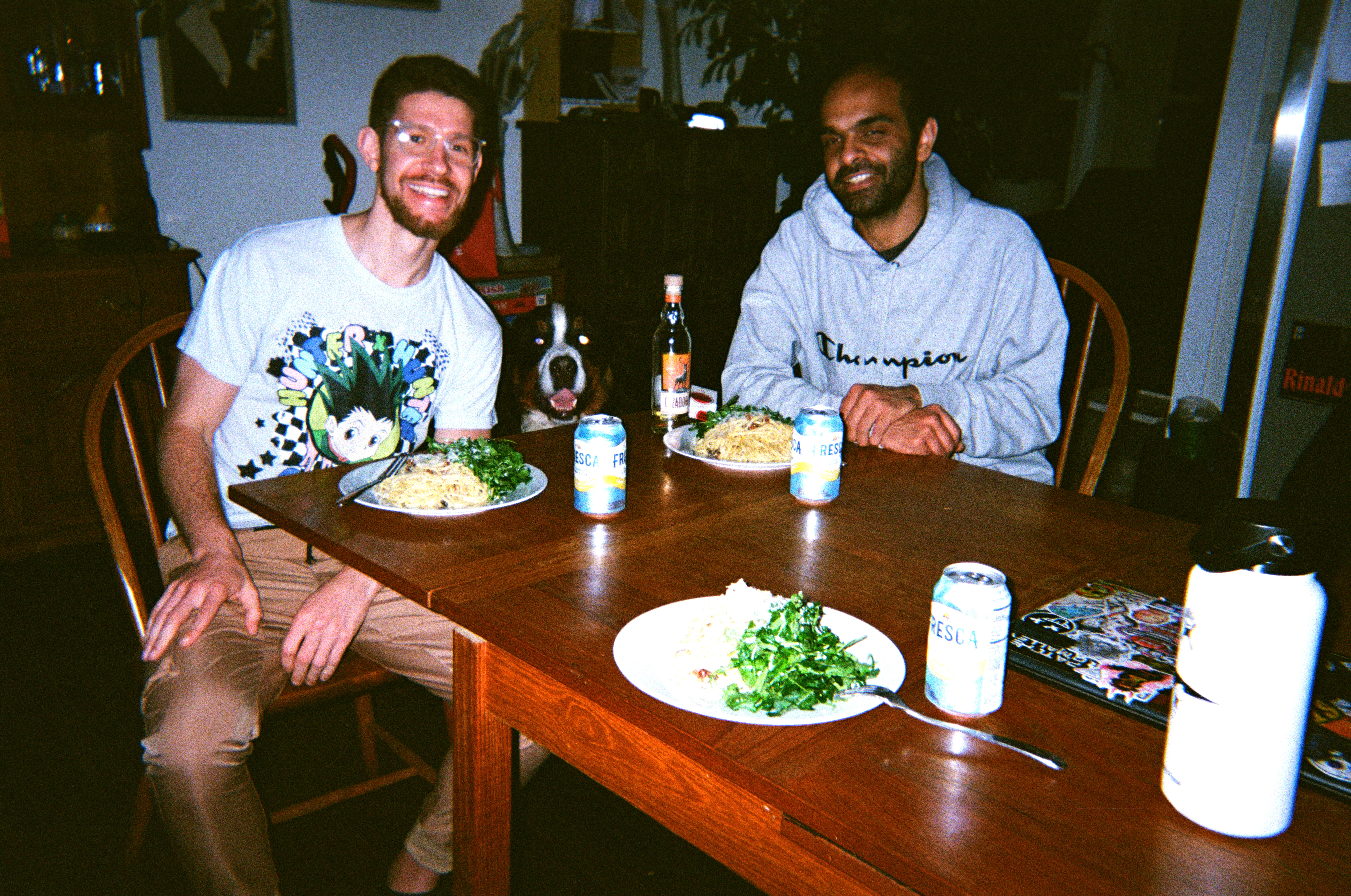
Two Sleep Piece #1 participants enjoy their dinner.
AC: Would you like to talk about a particular night, or the kinds of things that happen during these dinners?
CAK: Rather than talk about a particular night, I’ll talk about the patterns I’ve noticed. People, I think, interpret the piece similarly to how I [do]. My participants are interested in the same things that I’m interested in, intimacy and knowing each other, because a lot of the performance is just us talking and getting to know each other. People really frequently — and this has happened in all of my performances that I do with strangers — within the first hour, they’ll be like, “hmm… Well, I guess I’ll tell you my life story.” And they’ll tell me, like, everything, which then results in me sharing stuff about my life relating to them. That’s the main pattern I’ve noticed: Just, like, this pretty conversational connection.
We usually stay up, like, way too late — classic sleepover, having a deep conversation — and then the sleepover continues into the morning when we leave. So it’s always kind of cool to wake up together and then, um, see how the mood is different the next day and I’m still there. And I’m like, “If you need me to go, I can go!” and everybody usually lets me have a coffee with them and then we part ways.
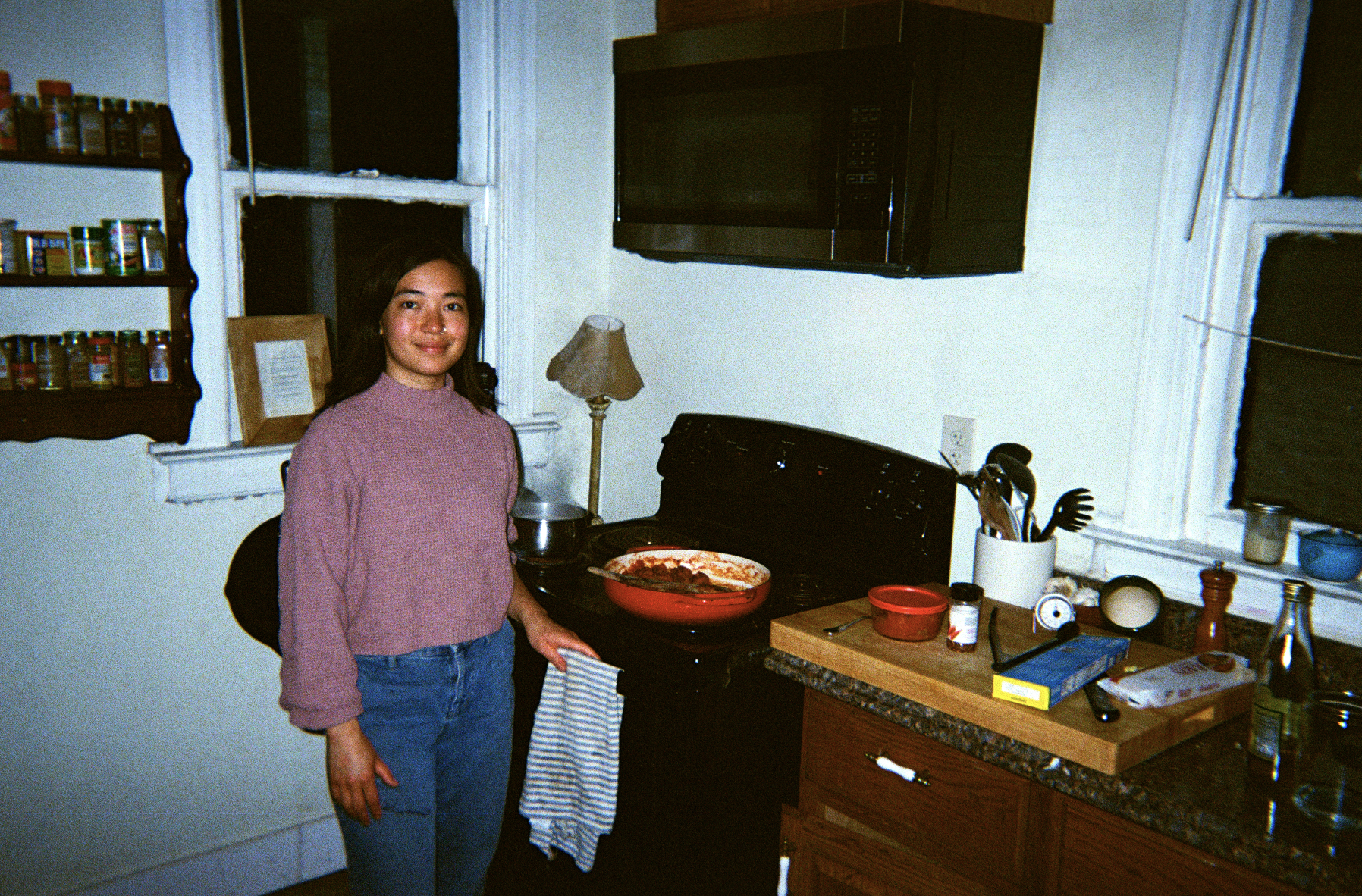
The artist makes dinner at a Sleep Piece #1 participant’s house.
AC: What kind of meals did you cook for this project?
CAK: Quite a few. It’s all based on what they want, so I’ve actually made Middle Eastern food, like Mediterranean food, multiple times. I made lentil soup twice; I made tabouleh a couple times; buttered noodles with breaded chicken; cheeseburgers with brussel sprouts and fries… Oh, and one person specifically requested grass-fed steak with asparagus. She told me that she did it as a test.
AC: A test!
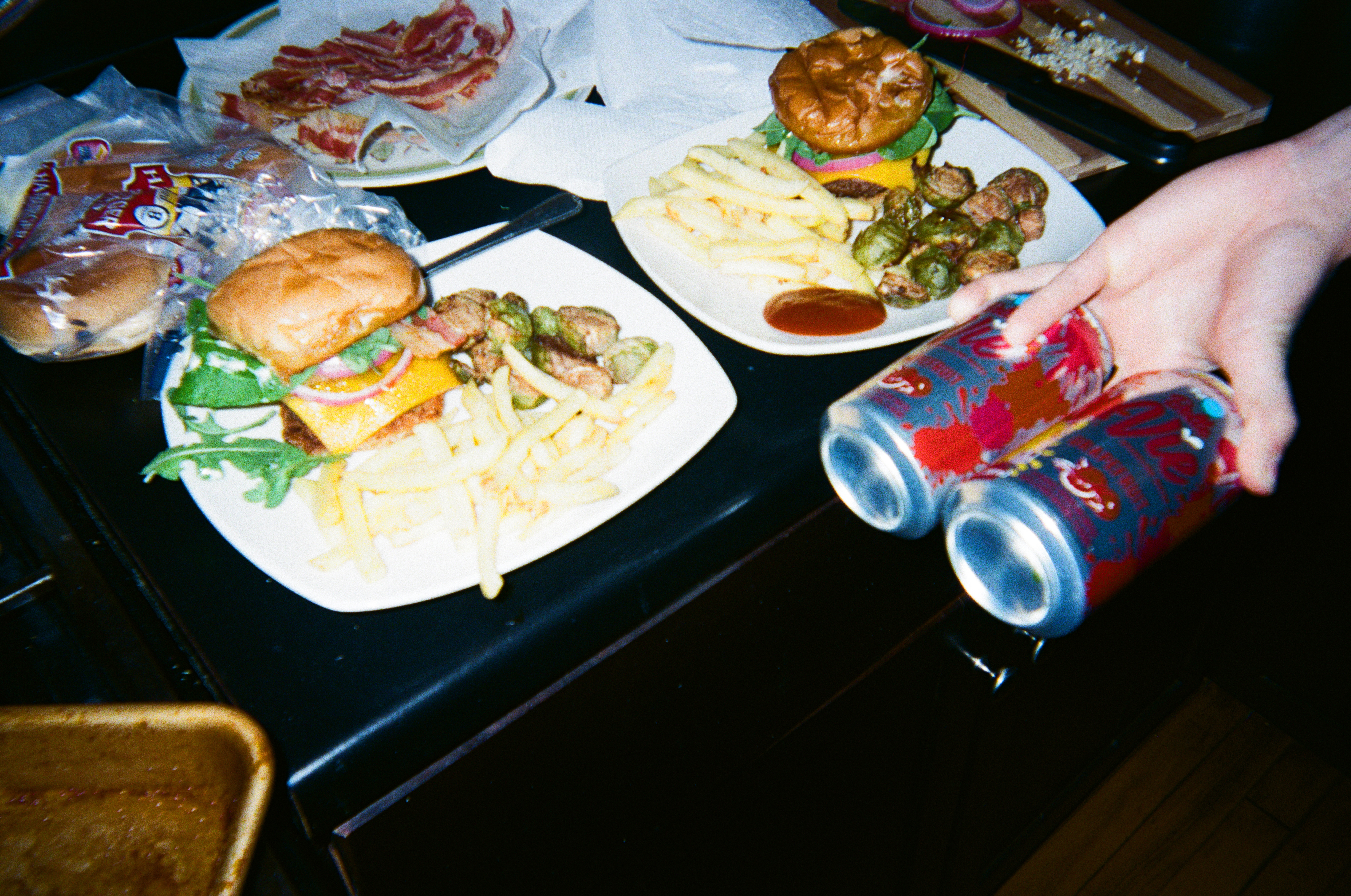
A typical meal for Sleep Piece #1: Burgers, fries, and brussels sprouts.
CAK: Because it’s expensive, and also it’s steak, so she was like, I wonder, what if this person’s a vegan? Are they going to eat with me? That kind of thing. But I don’t have any dietary restrictions, so I just end up eating like normal. But it is — whatever, whatever they want, I will make and I will eat it with them.
AC: This question applies to a lot of your performance art pieces, but in this new work specifically, do you find yourself acting differently within the bounded structure of the performance? Do you find yourself taking on any kind of persona, or doing anything differently than you would in your regular life?
CAK: I think the short answer is no. A lot of my work is informed by [that] I’ve been in customer service, the food service industry, since I was 16. I’m 29 now, so most of my life I’ve spent interfacing with the public, strangers, kind of having these brief intimate encounters with people. I was a barista; I was a bartender; I was a cashier, like, having regulars who come to you, specifically, just because you’ve developed a relationship. I think I have developed a skill of, like, this lack of codeswitching. I tend to interact with everybody roughly the same, even a stranger. I think I’m familiar with most people.
To that, I’ll say I feel like I really become authentic. Like, even if I’m comfortable, there’s still some sense of, like, “this is kind of weird,” [for] maybe two hours, and I notice after hour three a lot of the defenses fall away and we’re all kind of ourselves.
AC: Actually, I want to touch on the customer service, emotional labor side of this. I know in your interview with People’s World magazine your work was framed in this very socialist context, of, like, the alienation of labor. I don’t know if that’s something that you identify with professionally or that’s their take on it, but I’d love to hear about your politics as you see them, and how, if at all, your art relates to those politics.
CAK: For sure. Let me sit on that for a second.
Another word that I use for this kind of work is “social sculpture,” meaning that my participants — I mean, me too — but my participants and I, we create the world of the piece together. In, just like, entering the world in that sense: I mean, this is not a private studio practice, this is a public studio practice. This piece is not finished when I bring it to my participants. It is vulnerable in that way: I’m a little self-conscious, I’m grateful and self-conscious because I’m like, “thank you so much for making this with me.” I’m not bringing you a final product; you are a collaborator. I think in that sense, I’m very human-positive.
Rather than explicitly Marxist, socialist, et cetera — although this is a very material practice and this is very praxis-oriented — I feel like I’m more [in] sociocultural anthropology. I’m more autoethnographic, that kind of bent, which I think is inherently quite leftist. But I wouldn’t say it’s explicitly political. I’m also a woman of color doing this work, so there’s that thing too of, like, anything I do, whether I intend for it or I don’t, it’s gonna be about that, y’know?
I believe — I’m very influenced by existentialism, I would say, in my work. Sociopolitical existentialism, where every single thing that you do in the world matters. With my work, I’m never trying to be antagonistic, I’m never trying to be skeptical. I’m always going to do something that I think will benefit myself and other people.
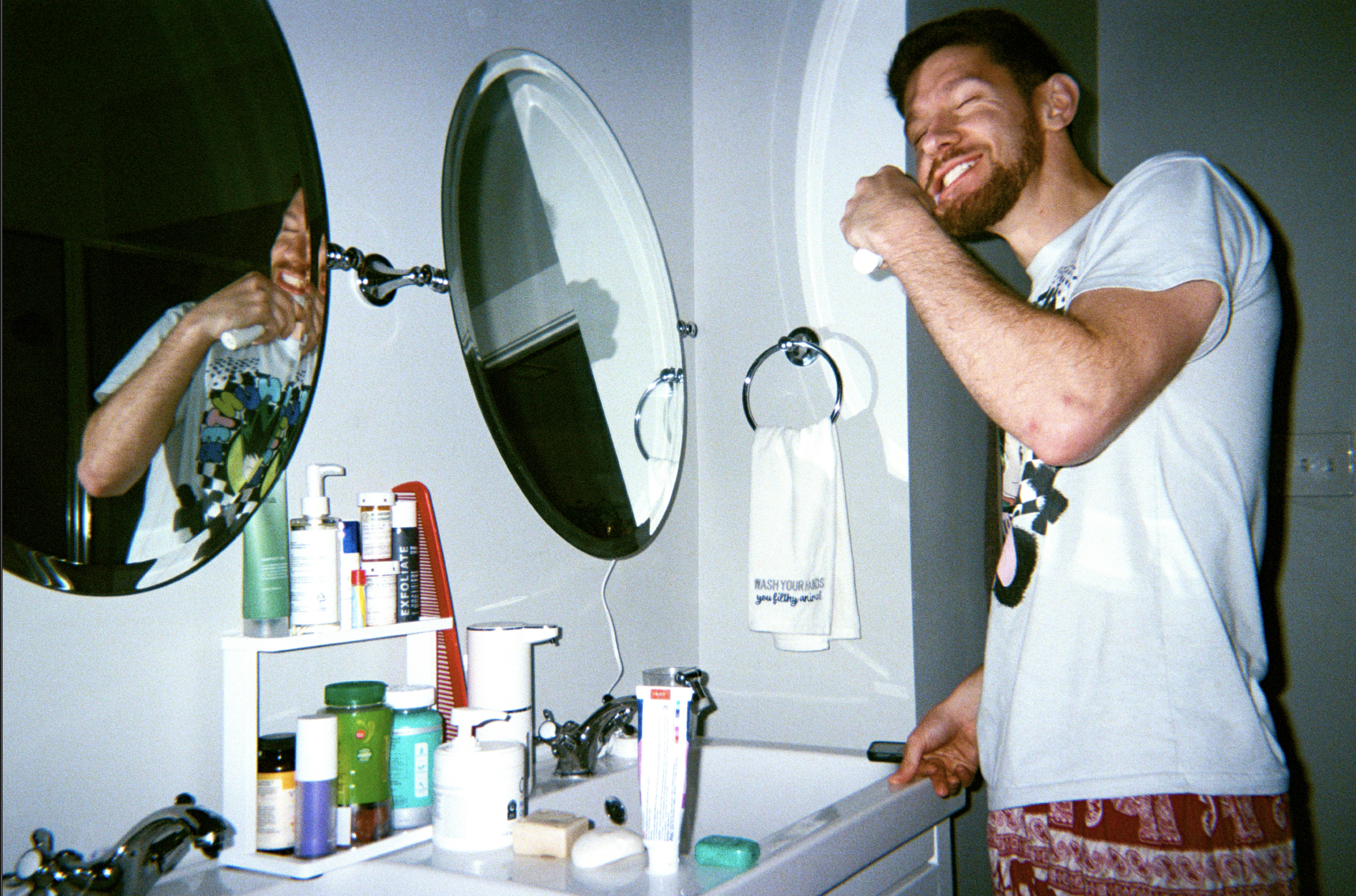
A Sleep Piece #1 participant brushes their teeth.
AC: This is making me think of other performance art pieces where you’re interacting with other people. A lot of it is in the interaction with other people, or the interaction with the space; I’m thinking of — Who was the artist who swept the floors of the [Wadsworth Atheneum] museum?
CAK: Mierle Laderman Ukeles.
AC: I think with her, and with other people who are engaged in interpersonal service, or institutional service, it seems like their work is less interested in the interiority of the artist, and more in the performance of intimacy or service. Whereas in your work, it seems like a lot of them involve material traces of your interiority. I think of Let Me Make You Dinner (2025); you have an ongoing performance journal that is published alongside the work. So, I’m curious about how much you see your interiority as part of the work, versus how other people interact with you, the art-object.
CAK: That’s something I think about a lot. I always say I really, selfishly, I really need to be changed by these works. My inspiration for this work — like I said about wanting the work to be good for myself and other people — the work is really largely about healing. All of it. [In] the Let Me Make You Dinner piece I was looking at Ana Mendieta’s Untitled (Rape Scene), I was thinking about Marina Ambramović’s Rhythm 0, Yoko Ono’s Cut Piece, this idea of being the woman alone in a private space and inviting people in to interact with me. I wanted to be like, it’s not always like that. I wanted it to be like, to let people come into your apartment, and the door is locked, and there’s no recording device, and you have a nice dinner and they leave. You know?
There’s a craft involved that I’m working on in myself of authenticity, vulnerability, the capacity to connect with people without fear, and I work on that through each of these pieces so that for the next piece I can become even more risky whilst knowing I’m being safe. It goes from, like, I’m in a public gallery, now I’m in my apartment, and now I’m in another person’s space.
I feel like I’m getting a little bit long-winded again, but my interiority matters a lot because I view that as part of the craft of social performance art, is the way that these pieces make me braver and more settled in vulnerability.
And I also feel like I’m not — I’m a person just like everybody else. I’m a person undergoing the same sociocultural influences as other people. And when I do this journal and I share my journals, I consider it a deeply subjective, but still empirical, record of what happens to a person when they do something like this.
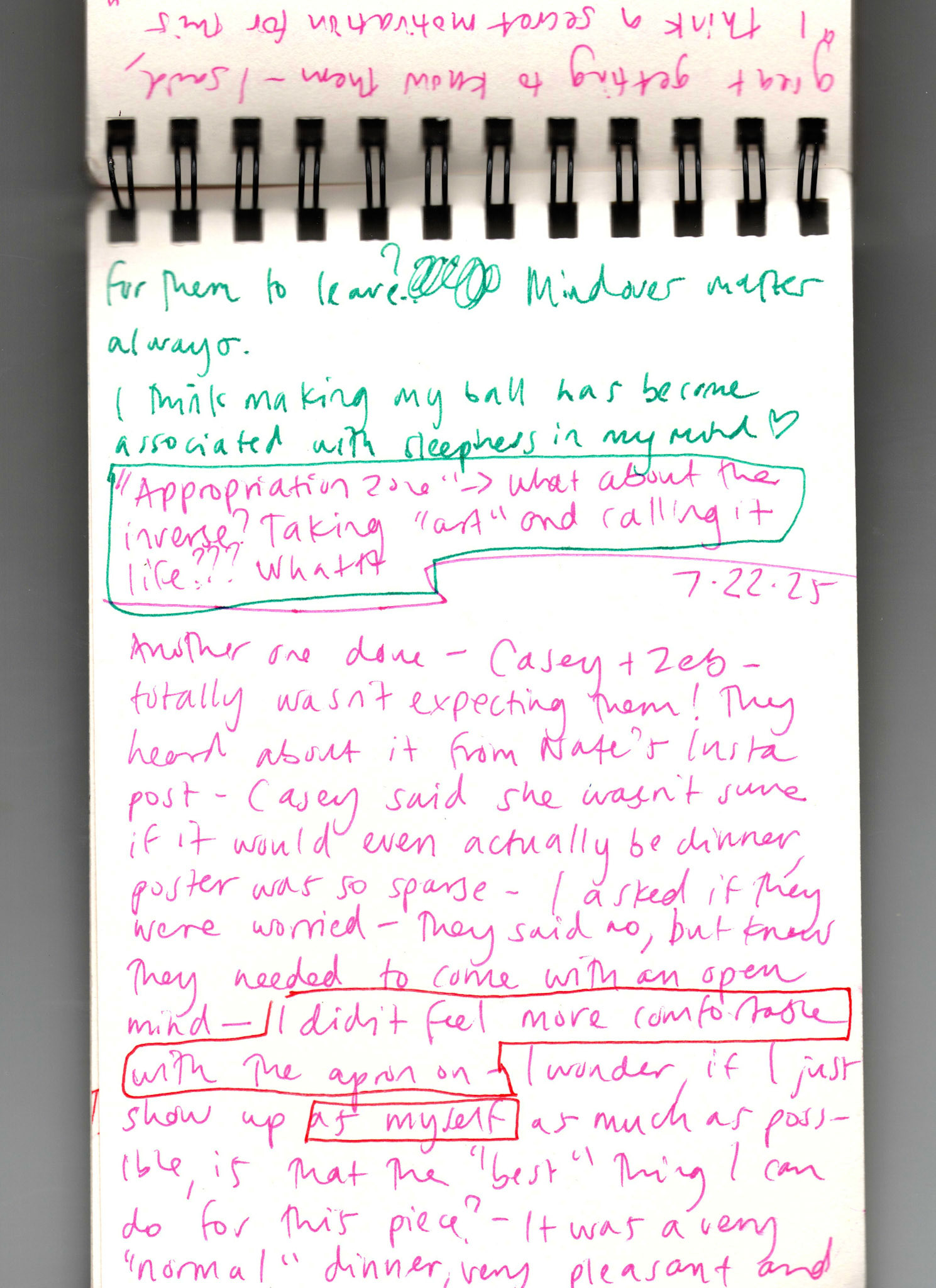
An entry from the Let Me Make You Dinner (2025) performance journal.
AC: Related to My New House (2025) and Let Me Make You Dinner (2025), especially those two, because those are staged in your house, or in a space that you control — [for] My New House, the studio. I’m curious if you’ve put any thought into this — maybe you didn’t, maybe you presented your space as-is — but I’m curious if you did any arranging of the space to accommodate the performances.
CAK: No, not quite. That’s one thing I’m interested in, too, is life itself as art. When I moved into my first apartment when I was 25, that was my first time fully being alone and creating a life alone as a single woman. And that, to me, was one of the most challenging, creative, and vulnerable things I’ve ever done. And when I had people [over for Let Me Make You Dinner] into my apartment, it was like… When people came who were artists, they looked: They looked in my bedroom, they looked in my bookshelf, and they were like, “did you set it up like this?” And I was like, “well, yeah, but like I didn’t change it for the piece.” Because that’s one thing I’m interested in: When does creativity — creativity can always be happening. When is it art and when is it daily life? And I’m really interested in pushing them together.
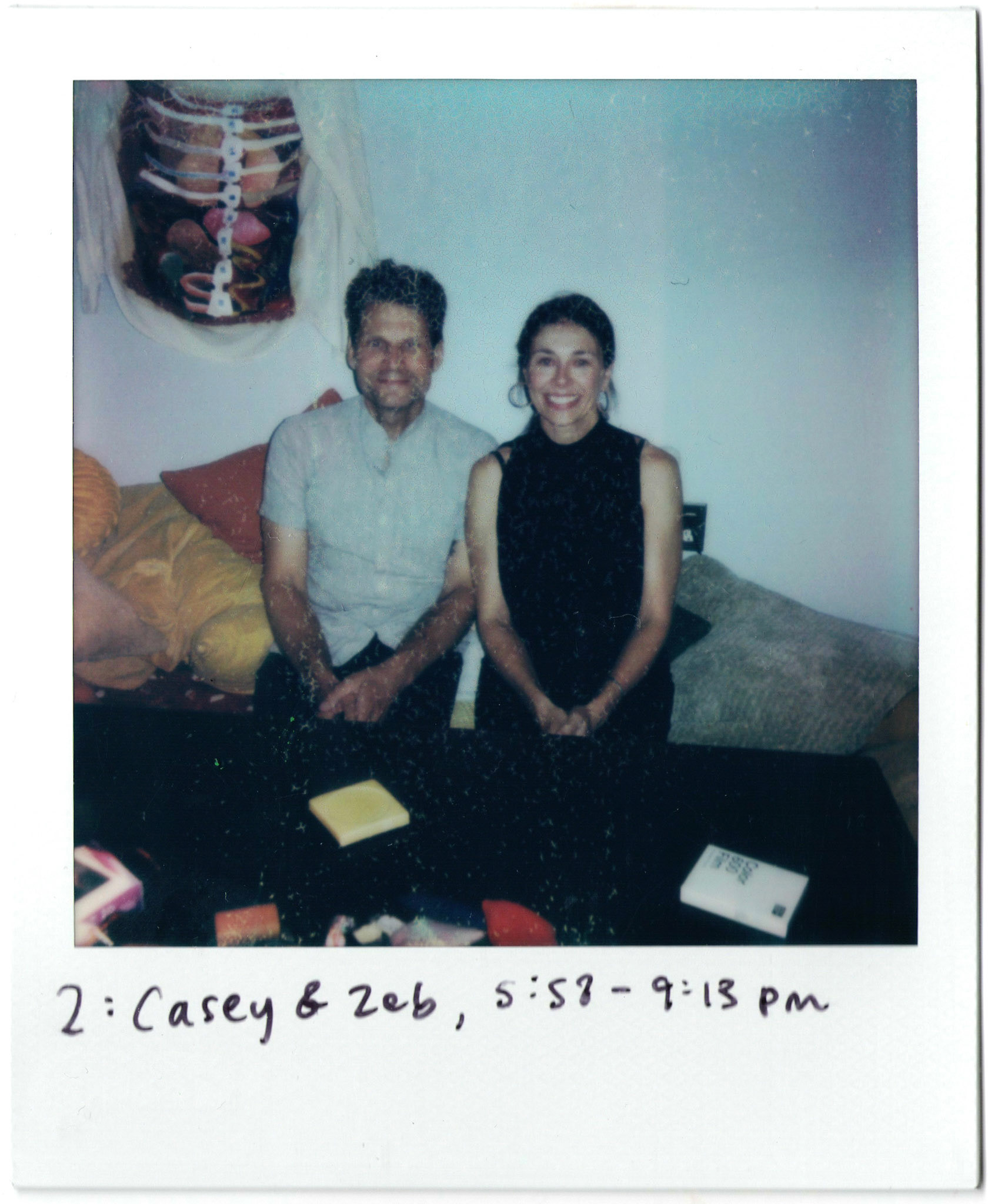
Two artist-friend participants come over for Let Me Make You Dinner (2025).
AC: Speaking of your artist friends! In your interview with People’s World, you namedrop a lot of well-known artists: Marina Abramović, Yoko Ono, very well-known people. I’m also curious if you find yourself with any local influences, in the Ypsilanti, Ann Arbor, Detroit area. It sounds like a lot of [local artists] drop in on your work as it is happening, and I’m curious if you consider yourself in creative community with them, and with whom, and with what kinds of work.
CAK: I namedrop this man all the time: Hugh Pocock. I reached out to him before I did my first performance piece ever because he was one of my professors in this international study thing I did, which is where I started exploring performance art. Pocock is, in my world, the one who coined the term “social sculpture” and he was the one who urged me to not make these pieces, like, rigid. When I was first going to do My New House (2025), I was going to do an hourly schedule where I’m doing stuff and it’s a performance and people can come watch. And he was like, “what if you just were there? What happens if the space opens up and people come interact?” So he is a huge person in my work.
In terms of local community — I mean the people who I have collaborated with now: C.G. Pierce, who actually wrote my article in People’s World, and then we ended up collaborating on a piece where I ended up counting the seconds of eight hours and they timed me, so that’s C.G.. My friend Emerson Granillo is also a durational performance artist, and they came for my first dinner in Let Me Make You Dinner. It was very exciting, you know? They’re big in my life because they put me onto my first curating gig. They taught me a lot about care in performance art, and the idea of, like, the durational performance of care and community.
And then also, I’ve met a couple people during this piece who I met through the piece. Had a sleepover with one of them, and we’re, like, collaborating on art projects together.
I feel like I’ll stop there, because I think I could keep going forever because my work is so... I always say that I feel like I never have an original thought, you know? It’s all influenced.
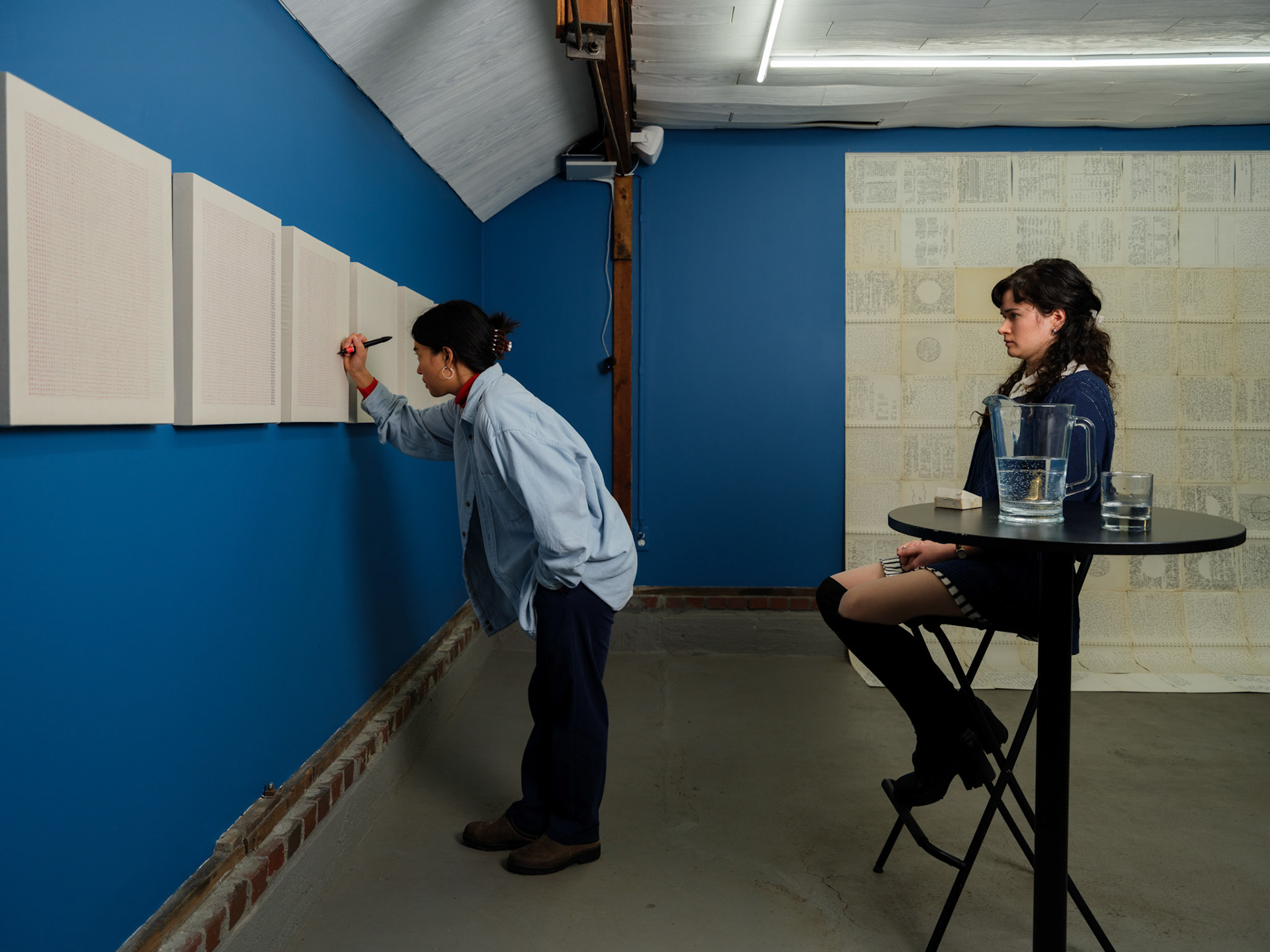
Chelsea Ayumi Koga and C.G. Pierce perform 29,980 Seconds (8 And A Half Hours) (2026).
AC: I know you’re at the end of this [piece,] but I am curious if this has sparked any future projects in mind; if there’s anything on your bucket list of pieces to do that this has brought about. So, I guess: What, in your heart, is next for you?
CAK: Heart! I’m still really interested in the “knowing” thing. I was interested in doing a piece called Do I Know You? where I put up flyers and it’s kind of like, let’s have some kind of correspondence for however long it takes for us to feel like we know each other, and then we’ll meet and we’ll see if we know each other.
It’s funny because I’m doing that today. I made a friend through this piece but we’ve only exchanged voice memos, that’s how we talk, and we’re gonna meet today. I don’t even know if that’s a piece. I also was thinking about Help Piece: I’m just going to put up flyers that say “Let Me Help You” and I’ll be your assistant, like, very open-ended assistant, for a month. And every week I’ll come over and I want to maybe get three participants, maybe, but for three months, every week I’m going over, helping. I’m wondering, like, what the word “help” means. You know? What does it mean to need help? Could it be talking? Sitting next to you? I’ve been thinking about service lately. Service is really in my mind.
I have a couple collaborations coming up: I’m going to be doing a durational performance, more formal, with my friend Emerson Granillo, and my new friend Nick Azzaro, and that’s at Midway. I have a show coming up mid-July. I received a grant for femme Asian-American artists, and I’m doing a performance and sculpture for that where I build a bed from scratch and I sleep in it in the gallery.
There’s always stuff, because these pieces are so inspiring because I don’t know what’s gonna happen and shit just comes up. I’m so inspired when I do them. I would recommend. Everyone should do it.
AC: Everyone should do performance art!
CAK: Everyone should! It makes my life so beautiful.
AC: I can’t imagine what it would be like to be in a community of performance artists! You’re just going over to people’s [pieces]... That’s so fun, that’s excellent.
CAK: It makes normal life exquisite and it makes performance unending. It’s awesome.
Chelsea Ayumi Koga’s next performance, Bed Piece #1 (if you ask to be held I will hold you), will take place at Swords Into Plowshares on July 17th, 2026.