




Karpov
October 20, 2025
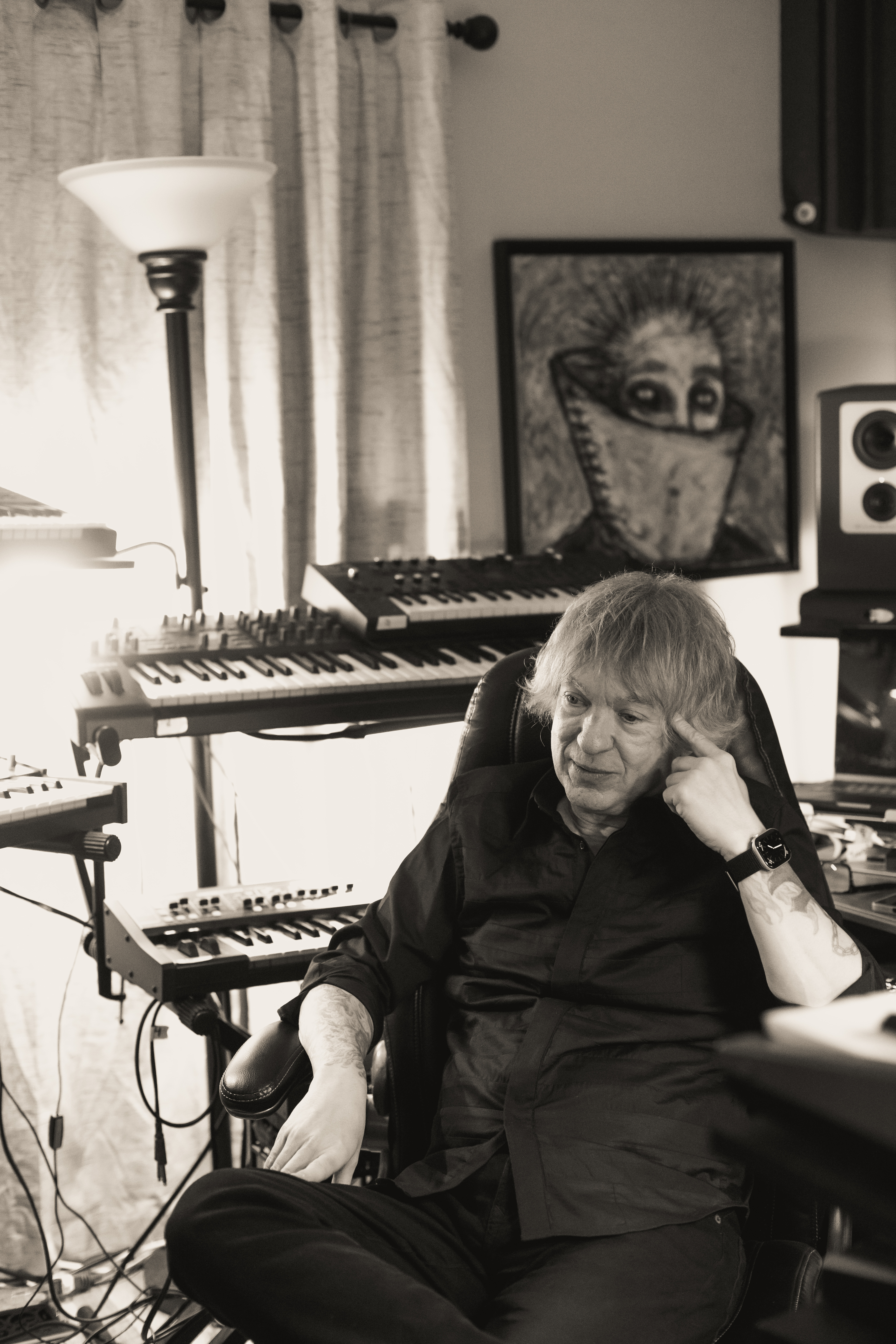
Chris Vrenna in his studio in Ypsilanti, MI. 2025. Photo by Miles Marie
A deep dive into the mind of a Grammy-winning producer, multi-instrumentalist, and educator...
*
The drive to Ypsilanti on this warm, sunny autumn afternoon feels like a pilgrimage of sorts. We’re heading to meet Chris Vrenna, a name that resonates through the corridors of goth music history like a carefully crafted echo. His fingerprints are on some of the most innovative and influential recordings of the past three decades, yet he remains refreshingly grounded, choosing to make his home in this quiet Michigan college town rather than the glittering epicenters of the music industry.
(Currently, Chris serves as an assistant professor of Performing Arts Technology at the University of Michigan). As our car winds through the tree-lined streets, I find myself reflecting on the remarkable trajectory that has brought Vrenna to this point in his career. Here is a man who helped define the industrial rock sound that would influence countless artists, who has worked alongside legends, and who now dedicates his days to nurturing the next generation of musical innovators.
The house that comes into view is unassuming from the outside, a testament perhaps to Vrenna’s preference for substance over flash. But as we approach the front door, there’s an unmistakable sense that something extraordinary lies within.
Chris Vrenna greets us at the door with the kind of genuine warmth that immediately puts visitors at ease. Vrenna is dressed in a sleek black shirt that speaks to his enduring connection to the alternative music scene, paired with black jeans. His hair, once the jet black of his Tweaker days, has evolved into a distinguished silver that frames his face with an almost ethereal quality. The transformation seems to mirror his own artistic evolution, from the intense young musician who helped craft some of industrial rock’s most seminal works to the seasoned educator and producer he has become.
The interior of his home reveals itself as a carefully curated gallery of the unusual and the provocatively dark. Vrenna’s passion for unique art pieces is evident in every corner, each work carefully chosen not just for its aesthetic value but for the story it tells and the emotions it evokes. The collection spans a remarkable range of styles and periods, from contemporary dark art to more Lowbrow pieces. As he leads us through the space, his enthusiasm for each work is apparent as he recounts the background of its acquisition.
But it’s when we enter his recording studio that the true scope of Vrenna’s artistic world becomes apparent. This is clearly the heart of the home, a space where cutting-edge technology meets timeless creativity. The centerpiece of the room is an impressive array of keyboards, each one representing a different era of electronic music and a different facet of Vrenna’s sonic palette. The walls of the studio tell their own story, adorned with memorabilia and artwork that chronicle Vrenna’s remarkable career. But among all these treasures, one piece stands out with particular significance: a striking self-portrait created by David Bowie himself. Our tour continues into a dedicated space showcasing Vrenna’s extensive collection of Adidas and Doc Marten shoes. The attention to detail in the collection is remarkable, with each pair carefully maintained and displayed, boxes and all.
As we make our way back to the studio for our conversation, Vrenna settles into a well-worn armchair that sits among the towering racks of keyboards like a throne in a kingdom of sound. What stands out to me is his approachability and willingness to engage with all kinds of questions. Unlike some established artists who are often guarded, he shows openness and genuine curiosity about our conversation. He reminisced about some of his most cherished memories within the music industry, illustrating not just his professional evolution but also the personal connections he has forged along the way. His dedication to music and teaching was evident in every word he spoke. His demeanor suggests he has found peace in his artistic journey and remains excited about the future.
Sometimes, it’s the simplest questions that allow someone to reveal the most about who they are and who they have been, and who they wish to be. This felt like one of those conversations that you just can’t avoid.
*
Karpov: What do you think happiness is?
Vrenna: That’s a great question. Lately, with my ongoing medical condition, I’ve redefined what happiness means to me. Now, what makes me happy is simply enjoying what I have. I’ve had to stop focusing on what’s next and learn to appreciate the present moment. Before, I could never slow down enough to truly enjoy what was happening around me. I’ve always been a fast talker, a fast worker, and a fast thinker. So now, happiness comes from slowing down and appreciating the moment. Since I can only focus on what’s in front of me, I’ve been forced to really live in the present. It’s made me reevaluate my life, especially what brings me happiness. I’ve realized that finding happiness is essential because, at the end of the day, that’s all that really matters. All the other stuff is bullshit.
Karpov: Are you more creative when you’re happy or unhappy?
Vrenna: I actually feel more creative when I’m happy. I have been diagnosed with depression and anxiety, which many people experience over the years. When I get angry, I tend to shut down and can’t do anything. Although many people use negative emotions to fuel their creativity, that’s not the case for me. If I can’t feel good about myself and my surroundings, I struggle to create. For me, creativity arises from having a positive self-image and outlook on life. When I’m in a good mood, I feel capable of doing something great. However, when I’m sad, it feels like everything is terrible, and I lose confidence in my abilities. I’m going to lose my elder goth status. [laughter]
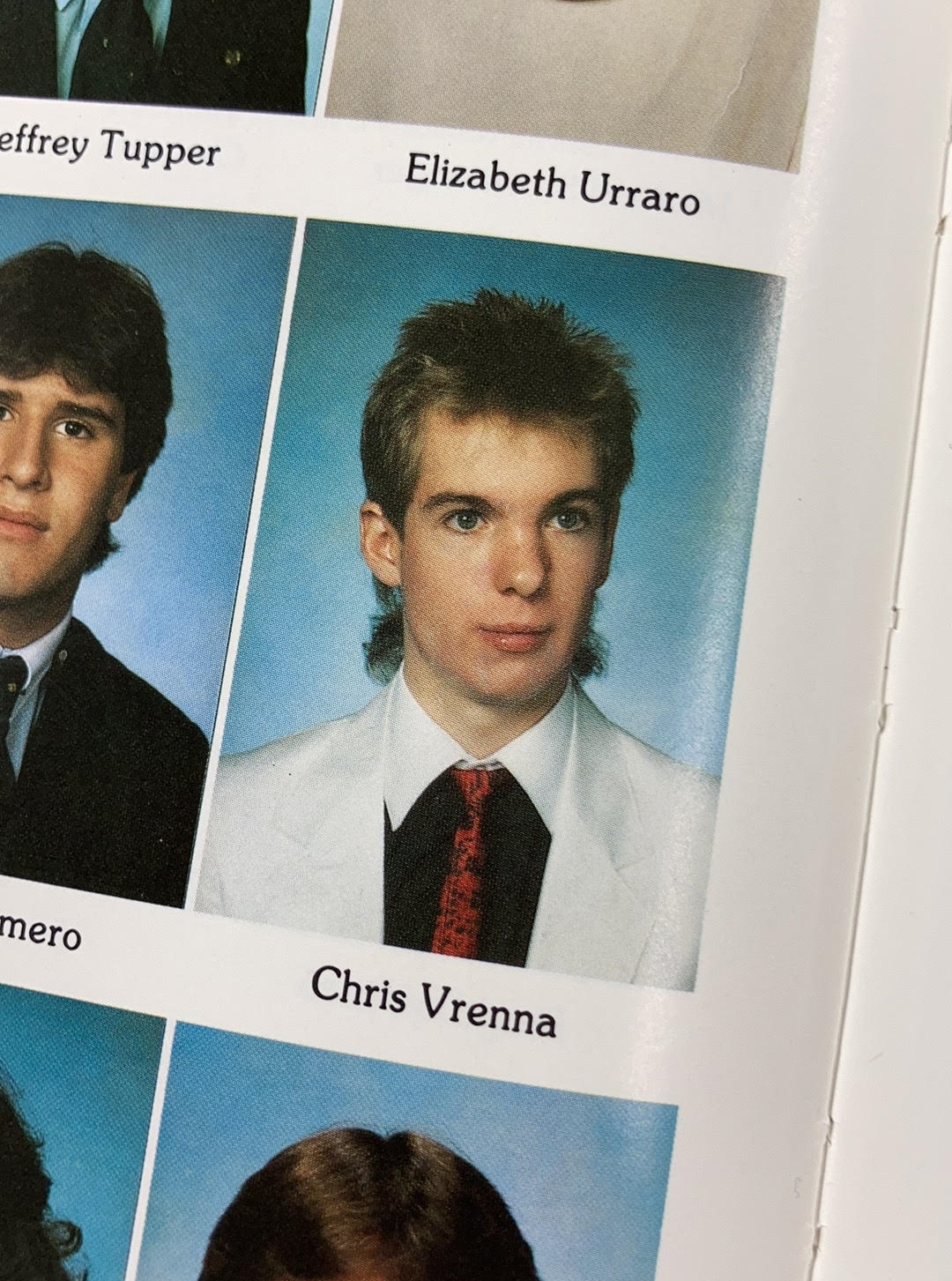
Yearbook Photo. Courtesy of Karpov
Karpov: [Laughter] Are there any particular bands that have influenced you to get into electronic music?
Vrenna: I’m a child of the 80s. I was born in ‘67. I graduated from high school in ‘85. So 80s trends were incredibly influential in my high school. I mean, if you look at all my old yearbook photos, I have spiky hair. One of them, I look like Flock of Seagulls. Skinny ties. I still have my skinny leather white piano key tie. I’ve kept all those in a tub in storage because they’re just too cool to get rid of. In a Modern Drummer magazine I loved to read, there was an ad for British electronic drums called Simmons. They were six-sided, resembling stop signs, with a hard-hitting surface that hurt your wrists. Bill Bruford from King Crimson played them in the ad, and I was intrigued.
I loved the idea of sounds not matching their sources, like hitting a pad and having it make a dog bark. I really got into electronic drums early on. Coupling that with Depeche Mode during the early to mid-80s was a game-changer for me. I even attended the Black Celebration Tour in ‘85 in Cleveland. I enjoyed a lot of bands from that era, including Erasure, the Thompson Twins, and Yaz. I also appreciate Kraftwerk and, like many others, Ministry’s album With Sympathy, which is an excellent Darkwave record. I’m thrilled that Al Jourgenson finally acknowledged that era and toured recently, playing both With Sympathy and Twitch.
Karpov: My favorite track off of Twitch is My Possession.
Vrenna: Oh my god, I love that track! Isle of Man is one of my favorites. Over the Shoulder, of course, is a classic kind of dance track. I was really into music and played in a synth band in high school with older guys. The bass player used a Yamaha keytar bass, and our guitarist had those signature chime-y tones. I was into that scene early on, but hadn’t gotten into industrial music yet.
After high school, I already owned a couple of drum machines. My keyboard player was friends with Trent Reznor, who is from Mercer, PA. Trent was selling a drum machine called a Linndrum, and my keyboard player told me about it. I was so excited that I asked him to tell his friend I wanted to buy it. So, we drove down to Mercer, and I purchased the drum machine—that’s how we first met. I used to go see a band called Exotic Birds, which Trent was in, but their drummer quit. Trent called me in my dorm room and said, “Hey, dude, we need a drummer for Exotic Birds. Do you want to bring your electronic drum set up on Friday and maybe jam with us?” I was thrilled and said, “Hell, yeah!” I already knew all their songs because I had been attending their shows and hanging out with them. We did that for a couple of years, but eventually, it fizzled out. Then Trent started writing his own songs, which would eventually become Pretty Hate Machine in 1989.
Other influential albums for me and my music evolution included one of my all-time favorite albums by Skinny Puppy called Mind: The Perpetual Intercourse. Other bands that influenced me were Nitzer Ebb, Revolting Cocks, My Life With The Thrill Kill Cult, and perhaps my favorite band of all time, Rush.
Karpov: How has the evolution of music technology affected the way you work?
Vrenna: The first Nine Inch Nails record, Pretty Hate Machine, was recorded on 24-track, 2-inch analog tape. Trent had a Mac Plus for basic MIDI sequencing, but much of the music had to be played live. As technology advanced, hard disk recording became standard, allowing for easier editing and looping instead of needing two 24-track machines.
Today, we live in a world dominated by laptops and tablets, but my experience hasn’t changed much. I still use Pro Tools, which has had MIDI for 25 years. However, younger generations, like my college students, have grown up with technology such as iPads and iPhones. Everything has shifted to software, making it more accessible. You no longer need to spend a fortune on equipment to be successful; a laptop and software can suffice.
This makes some things better, but it actually makes other things worse. One issue is that people see it as a shortcut to success. They think they don’t need to learn instruments because software like Apple’s Logic can automatically adjust loops for tempo and key. As a result, fewer people learn to play music, especially with today’s distractions from platforms like Spotify, TikTok, and Snapchat. Now, because everyone has access to the same software, everything sounds the same, and many don’t bother to learn it well.
, Trent Reznor, James Woolley, Richard Patrick.jpg "InConversationChrisVrenna.Karpov")
NIN Magazine cutout, Vrenna (Left), Trent Reznor, James Woolley, Richard Patrick. Courtesy of Karpov
Karpov: You currently teach music technology courses. What motivated you to come to the University of Michigan?
Vrenna: My father graduated from the University of Michigan, so I grew up as a huge Wolverines fan. Getting the offer to teach here was the perfect opportunity.
Education has always been important to me. I started drum lessons at age 6. I went to college at Kent State University in 1986, but when Nine Inch Nails began to take off in 1988, I decided to drop out. I had about a year left to complete my degree, but I knew in my bones that the band was going somewhere. I did eventually go back and finish my degree, as well as completing a masters degree in 2020.
In 2012, I started receiving invitations from several colleges that teach music technology—schools that actually had multiple recording studios—to give guest lectures and participate in workshops. A friend also asked me to volunteer some time with at-risk youth in East Hollywood, which I did a few times. I discovered that I really enjoyed doing this.
Everything came together at once when a school in Wisconsin invited me for guest lectures. I was surprised that such opportunities existed and could lead to a career in education. In the summer of 2013, I tore my rotator cuff, requiring surgery and nine months of physical therapy.
Two weeks post-surgery, the school in Wisconsin contacted me with a full-time instructor position. I discussed it with my partner, Melissa, who agreed it might be time for a change after 20 years in L.A., making this a great opportunity to try something new. So, I accepted the offer and we moved to Wisconsin. I taught at that school for five years until it closed. Then I spent six years in Huntsville, at the state’s largest two-year college, where I developed a music technology program, writing the curriculum and providing all the necessary gear. For me, crafting a curriculum was as creative as making music—transforming ideas into something enjoyable. Teaching felt like performing, with my class as the audience and my lesson plan as the set list.
I feel that I’m paying it forward to young people and sharing what I’ve learned along the way. And that led me here to teaching at the University of Michigan.
Karpov: I want to discuss your time with Nine Inch Nails. How has it influenced your music and production style?
Vrenna: Everything I’ve done has contributed to my teaching philosophy, almost like a mental organizer. My time in Nine Inch Nails has shaped my musical vocabulary, and I’ve picked up influences from various artists, including Manson and Gnarls Barkley. Currently, I’m working on a new Tweaker EP. A lot of the hardware here in my studio is vintage. I re-acquired a Nord Lead and a Virus, the only two synthesizers I had when making the first Tweaker record, along with a sampler. I want to reconnect with that spontaneity of using hardware instead of software, so I’m going retro for this project. All my experiences continue to influence me, and I still listen to a lot of older music. While I try to keep up with new music, I’ve found myself diving even deeper into my musical roots. Recently, I’ve been really into Coil’s album Love’s Secret Domain, which is so fucking good. I’ve also been revisiting Skinny Puppy and Throbbing Gristle.
Karpov: What are your reflections on your time with Nine Inch Nails? How did you initially react to the news of Nine Inch Nails being inducted into the Rock and Roll Hall of Fame?
Vrenna: I’ve gone through different phases in my life, and it all goes way back. We can circle back to the first question about happiness. I left the band, and things were pretty grim. Trent’s been quite open about that time, too; he was in a very dark place, and I just couldn’t help him. And I couldn’t be around it.
My band Tweaker opened for Skinny Puppy years later (it was the only tour we ever did), and the last stop was in LA. After our performance, I packed up the Tweaker gear and went up to the balcony in the theater. As I was walking up the steps, I ran into Richard Patrick and his wife. While I was standing on that balcony, Trent and I locked eyes for the first time since I left the band in 2004. I realized there was no way to get off that balcony except by the stairs I had just climbed. We were forced to say hi and shake hands. He had come to see my band, Tweaker, live, and he said, “Dude, the show was awesome.” I replied, “Thanks, man,” and we exchanged a hug. We have stayed in touch through the years.
Then the Rock and Roll Hall of Fame induction happened. I’m not sure how I found out about it; I think I saw it online. I saw a post about the inductees, which included Depeche Mode and the Doobie Brothers. The very next day, I received a text from Trent asking if I had time for a phone call. I said yes, and we spoke on the phone. He mentioned the Hall of Fame induction, and I congratulated him. Then he said, “Well, congratulations to you too.” Unfortunately, our induction ceremony in 2020 was cancelled due to the COVID pandemic. We never did get a proper ceremony, but in 2022, they hosted a Rock and Roll Hall of Fame weekend with Nine Inch Nails. They flew everyone to Cleveland for the festivities. There was a roundtable Q&A, which you can watch on YouTube. It was a nice fan appreciation event at the Rock Hall of Fame. The following night was a concert, which was the last of the rescheduled Nine Inch Nails shows from 2020 and 2021. It took place at Blossom Music Center in Cleveland.
We did a surprise reunion set with us former members along with the current band. We played Eraser, Wish, Gave Up, Sin, Filter’s Hey Man, Nice Shot (sung by Richard Patrick), and closed with Head Like a Hole. The fans were surprised, and it was just a wonderful weekend.

Chris Vrenna at home in Ypsilanti, MI. 2025. Photo by Miles Marie
Karpov: I learned that you lived and worked in the guesthouse at Sharon Tate’s residence, where the infamous Tate-LaBianca murders occurred. What was it like living there while recording both the Broken EP and The Downward Spiral?
Vrenna: Although I wasn’t present, they took Trent to view several houses that might be suitable for recording. Rick Rubin has a passion for placing bands in houses for album recordings; it’s one of his signature approaches. The Tate house was among the houses they showed Trent.
The main road from Beverly Hills leads to Cielo, where you turn left, and it winds up to a dead end right at the gate of that house. It’s the last house on the road. When you stand in the front yard, the view is breathtaking. On a clear day, you can see Catalina Island way off in the distance and all the way to Century City. Downtown L.A. is right there; you can see it all the way to the east. Nobody wanted to buy the house because it was small and old, not to mention the fact that there was a famous murder that took place there.
While we were living and working there, the owner was actively trying to sell the house to celebrities. I don’t remember all the celebrities who were brought to see the property, but one who stands out is Jean-Claude Van Damme. One day, while we were working in the studio, I looked up and saw our landlord with Van Damme. I simply gave him a peace sign and then went back to work, treating it like just another day. We lived there for about two years and four months. When the owner of the house couldn’t sell it, they decided to demolish it. The bulldozer tore down the house right in front of us. It was quite an experience. We ended up being the last people to ever live there. And Trent kept the front door.
Karpov: What is the song that you let yourself live in the most?
Vrenna: It’s likely not what anyone would expect, but it would definitely be Depeche Mode’s Enjoy the Silence. It’s a beautiful track, particularly because of the lyrics. One thing Martin Gore has always excelled at is musical counterpoint. After the chorus, there’s a melody that comes in at the end, along with a hook that Dave Gahan keeps singing, while another new part layers on top. This builds into something really special. I’ve always said this might be my favorite Depeche Mode song of all time.