




51st states, Complicit Americans and the Importance of Not Being a Single Ant
Aisha Sarwari
February 23, 2026
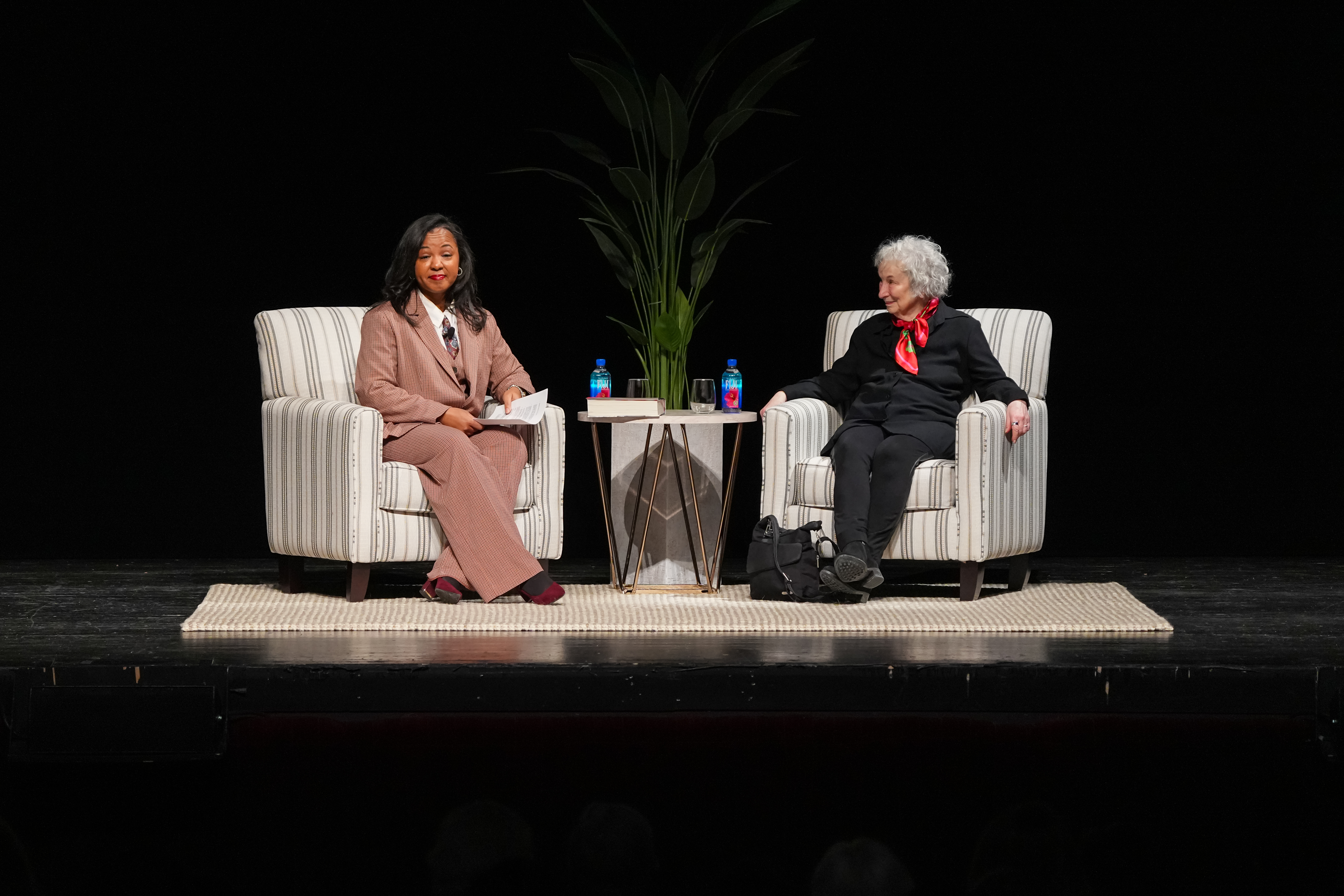
In Conversation: An Evening With Margaret Atwood at The Detroit Opera House, January 26, 2026, moderated by Sam White, the founder of Shakespeare in Detroit.
Photo courtesy of Detroit Opera / Austin T. Richey.
Margaret Atwood walked onstage at the Detroit Opera House on January 26, 2026 like someone who has lived several lives and written several more. Her latest book is a memoir, Book of Lives, where she talks hair alongside other existential questions. Her hair, once compared to Medusa’s, has long fed the myth of the witchy, unhinged woman writer—someone more likely to end up like Virginia Woolf than to be sitting upon a white sofa in downtown Detroit at 85, taking the train from Toronto to dodge winter-flight chaos.
I first wanted this night when I was 15.
The Handmaid’s Tale in my hand at the library of a high school in Kenya, and getting nothing much from it at first. My English comprehension was like any non-native English speaker. But I read and re-read it again until I got it. Then it struck me: The world is vast yet, mine is small just like the protagonist Offred. That was the day I decided never to change my maiden name. To be of a man who claims you though marriage is etymologically idolatrous.
I am 45 now.
I finally got this night.
To see her in the flesh, just a few feet away.
It strikes me how tiny she is.
In between these years, I collected a shelf of her larger-than-life books—half unread, half the 50 that split my life open like a cracked egg.
Onstage, she read the egg passage from The Handmaid’s Tale, the novel that has become a secular scripture for anyone who saw Roe v. Wade’s reversal coming long before the decision dropped. In that same book, you can feel the premonition that Dr. Christine Blasey Ford would stand up and testify, and that Brett Kavanaugh would still rise to the Supreme Court because the violence against her was deemed too old, too unclear, too inconvenient to count.
When women write, their sanity is always on trial.
Atwood quoted Offred: “Sanity is a valuable possession; I hoard it the way people once hoarded money.” In that hall, her poise felt contagious. She gave us her energy and her wit, and in equal parts her intelligence, political sharpness and stubborn courage.
In Book of Lives, she offers where she was when she wrote her body of work. For The Handmaid’s Tale, she went to Kabul despite her father’s warnings that the government would fall. Child in tow, off she went—only to be interrogated. This was a time when the Soviet Union and United States were at war in the 70s, and the Taliban were being manufactured to wage a war against the infidel Soviets—U.S. and my country, Pakistan, in cahoots to shape-shift Islam for short term gain. Now the Taliban lord over the women, flog them and veil them both indoors and outdoors and use them primarily to lay eggs.
It is not as if the world has been kind to her.
She has heard every insult reserved for a woman with a mind and a mouth. In relationships she braced relationship woes. When her partner, Graeme Gibson, died after decades together, she went on the Ed Norton show a day or so later. “It was either that or going back to an empty house,” she told us, then added, almost as an afterthought, “I could always do that later.”
Urgency hangs over her like the red statement scarf she wears.
In conversation with Sam White at the Detroit Opera House, she described how the Canadian Prime Minister, Mark Carney, delivered a scalpel-sharp critique of an American president’s trade war at Davos last week without saying his name, as if reminding us that resistance can be strategic as well as loud. It echoed that famous command from The Handmaid’s Tale: “Don’t let the bastards grind you down.” That line has given generations of women a private password, a way to recognize each other as sisters, not “aunts”—those tyrannical enforcers of the patriarchy in red.
“One ant is no ant,” Atwood said. “Artists need artists.”
Her plea was simple: read more, watch more, give art your time and your attention. Not as a luxury, but as a survival tactic.
So, we stood.
In the heart of what was once American manufacturing muscle, an American audience rose for the Canadian national anthem. A few blocks away, Diego Rivera’s mural still shows workers inhaling poison to feed a nation—bodies bent over pistons, hands veined and swollen, labor turned into a patriotic sacrament. A fetus floats in one panel, cradled by two women linked to it by cords. You can feel Frida Kahlo’s touch there, insisting that even within the machinery, there is a womb, an egg, a future that demands care.
Atwood didn’t hold back her concern for the immigrant workers of today, those aspiring to freedom against unchecked power. In the Philippines, when extra-judicial killings took place, they were called “salvaging.” That is what she called the public executions, with people hung on the walls of Gilead, the dystopian city in The Handmaid’s Tale. Then she did not even say it but we all thought of it: the near dozen men and women killed by ICE agents for protesting the immigration raids, the new McCarthyism, the new America somehow at a loss because the jobs are being taken by the men Diego Rivera painted in his murals. Certainly, his wife Frida Kahlo’s influence on him shone through. We need eggs. We need nests to home them.
Eggs kept returning to us last night.
Atwood read, “I think that this is what God must look like: an egg. The life of the moon may not be on the surface, but inside. The egg is glowing now, as if it had an energy of its own. To look at the egg gives me intense pleasure. The sun goes and the egg fades.” In The Handmaid’s Tale, whoever controls the egg—women’s bodies, pleasure, reproduction—controls the light itself. Switch it off and you don’t just kill choice; you dim the source of life.
“We are going to remain separate,” she said firmly when the conversation edged toward fantasies of folding Canada into some American “51st state” dream. She has never hesitated to speak truth to American power, perhaps because she has already done it to her own. She reminded us that where the United States cages young Black men, Canada cages young Indigenous men—a mirror no one in North America should look away from.
Just outside, a BLACK LIVES MATTER sign faced the Opera House.
Inside, we were told that her stage adaptation of The Handmaid’s Tale will debut here in early March. “What you can do with film you cannot do with a book,” she said. “What you can do with a play you cannot do with film.” Each form, another way to press on power.
She told the story of a Danish composer, Poul Ruders, who once dropped to his knees in front of her at a Copenhagen conference. She knew it wasn’t a proposal; it was a plea: let me turn your work into opera. Her calculation was brutally simple: if it failed, people would forget; if it worked, the story would get a new life. She said yes. That is Atwood: always letting the work reincarnate, never letting it fossilize.
Even her environmentalism is narrative.
One day, after her death, a book will appear, printed on paper made from a tree grown from a seed she has already planted. Only when the tree is old enough to fell will the pages be pressed. It is a stunt, yes, but also a sermon: remember where stories come from, from trees and sun and time. Remember that the same sun that warms the egg also bleaches the plastic choking our skies.
The birdwatcher in Atwood gave us one last metaphor: “You cannot simply say, ‘Look, there’s a bird on a branch.’ ” You must give people a reference point. Sometimes, she said, a bright trash bag in the landscape helps: “Look 90 degrees from that yellow trash bag.” Her point landed as sharply as any policy memo: we need fewer plastic markers and more living landmarks.
“Are we complacent?” asked moderator Sam White—a local Shakespeare in Detroit director who seemed to want reassurance. “It’s not just that we are complacent,” Atwood replied in that soft, almost monotone voice. “We are complicit.” The room hummed. Her sentences kept setting off these low, collective vibrations, like a tuning fork struck again and again.
“What America is doing is not good for America,” she went on, “and it is not good for the world. That much is clear.” No pyrotechnics, just the cool exhaustion of someone who has been warning us for half a century.
She is smaller now than in the author photos on my bookshelf.
Her hair, white as Detroit snow, still refuses to behave.
She still means business.
Sam White marveled at how many books she has written.
“That’s a lot of books,” White said.
“Not when you look at how long I’ve lived,” Atwood shot back. “Joyce Carol Oates wrote more.”
The audience laughed, but it was the laugh of people being reminded they have no excuse.
The generosity in the room felt bottomless. Where did it come from? Maybe from a lifetime of being misread and still showing up. Atwood once appeared in a moth-eaten pink shawl, and a student journalist described her as “a Q-tip on fire.” She included that line in Book of Lives and added, “She will go far.” It takes a particular kind of confidence to quote your own burn and turn it into a blessing. Or maybe you just have to be living your life and writing from it.
Watching her last night, I thought this is what it means to be a permanent bride to the truth. Even in seasons of anarchy, mean girls and bad hair days, she keeps walking down the aisle toward it, again and again. Detroit got to be the latest witness.
We were not just an audience; we were her choir of hums.
This conversation came ahead of Detroit Opera’s performances of the opera The Handmaid’s Tale—based on the Margaret Atwood novel—on March 1, 5, and 7, 2026.
https://detroitopera.org/show/the-handmaids-tale/