




Ashley Cook
June 20, 2025
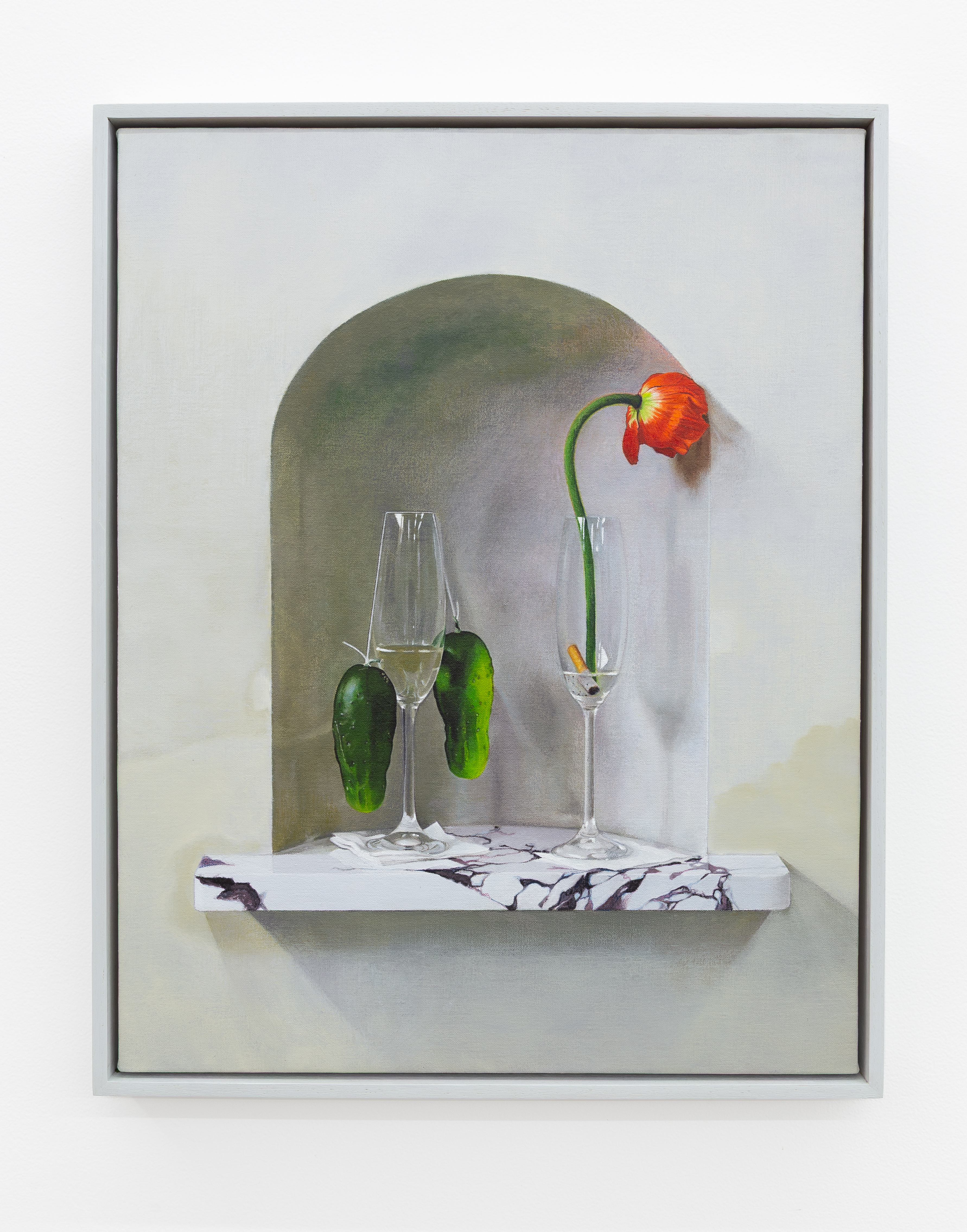
Punch and Judy, 2025. 28 × 22 in (71.12 × 55.88 cm), 29 ½ × 23 ½ in (74.93 × 59.69 cm) (framed) Image Credit: Alivia Zivich
AC: Um, so, okay, so the first thing I want to bring up is you were the first person who was featured in the magazine in 2020. Where were you at that time? Had you shown at Art Basel yet?
NS: 2020 was kind of my first big year work-wise. 47 Canal had switched up their programming plans by then, shifting their strategy so that every art fair they had a roster of seven artists that they knew could sell work. They would take these artists to every art fair, and that meant that for us, there was this constant rolling deadline every three months.
AC: What fairs were they participating in at that time?
NS: Starting at the beginning of the year, they would do Art Basel Hong Kong. They didn’t do Frieze in New York, but they would always do a special exhibition during that time. Then they would do Basel in Switzerland in June, London in September, Paris in October, and then Miami in December along with an extra thing here and there. I think 2022 was my first time doing a solo booth in Hong Kong.
AC: Wow, that’s pretty a big deal.
NS: Yeah, that was a lot of work.
AC: How many pieces went into that?
NS: Um, three humongous paintings and one small one. The pandemic was crazy for a lot of reasons. Cave (a Detroit studio cooperative where I had my studio at the time) shut down for a few months, so I was unable to work in my studio, but my deadlines were so tight that I had to get back in as quickly as I could. I remember moving some work out of Cave and working at my house for a little while. But yeah, it was a hectic period. Honestly, I kind of thrive on that stuff. I enjoy this consistent, busy schedule. This is the first year where I am only doing two fairs; usually I do at least three fairs, sometimes four with Canal.
AC: Are you doing other shows with 47 Canal as well, to fill the gap?
NS: I opened a show with them in November, but the art market obviously is not what it has been in the past, so they were only able to sell half that show (it opened three days before the election). When Trump got elected, and he started instituting these tariff plans early in the year, that threw Hong Kong for a loop. So, I started working on these three new works for Art Basel in June in January.
AC: Do you have any other exhibitions coming up after Basel?
NS: Well, I thought I would have one in a church in Italy that’s now an arts institution in this tiny little town north of Venice. But, after the show opened in November, they wrote to the gallery saying they thought that my show was “too strong” for an Italian audience, so instead of having another exhibition of my work this year, it got pushed back to like 2027.
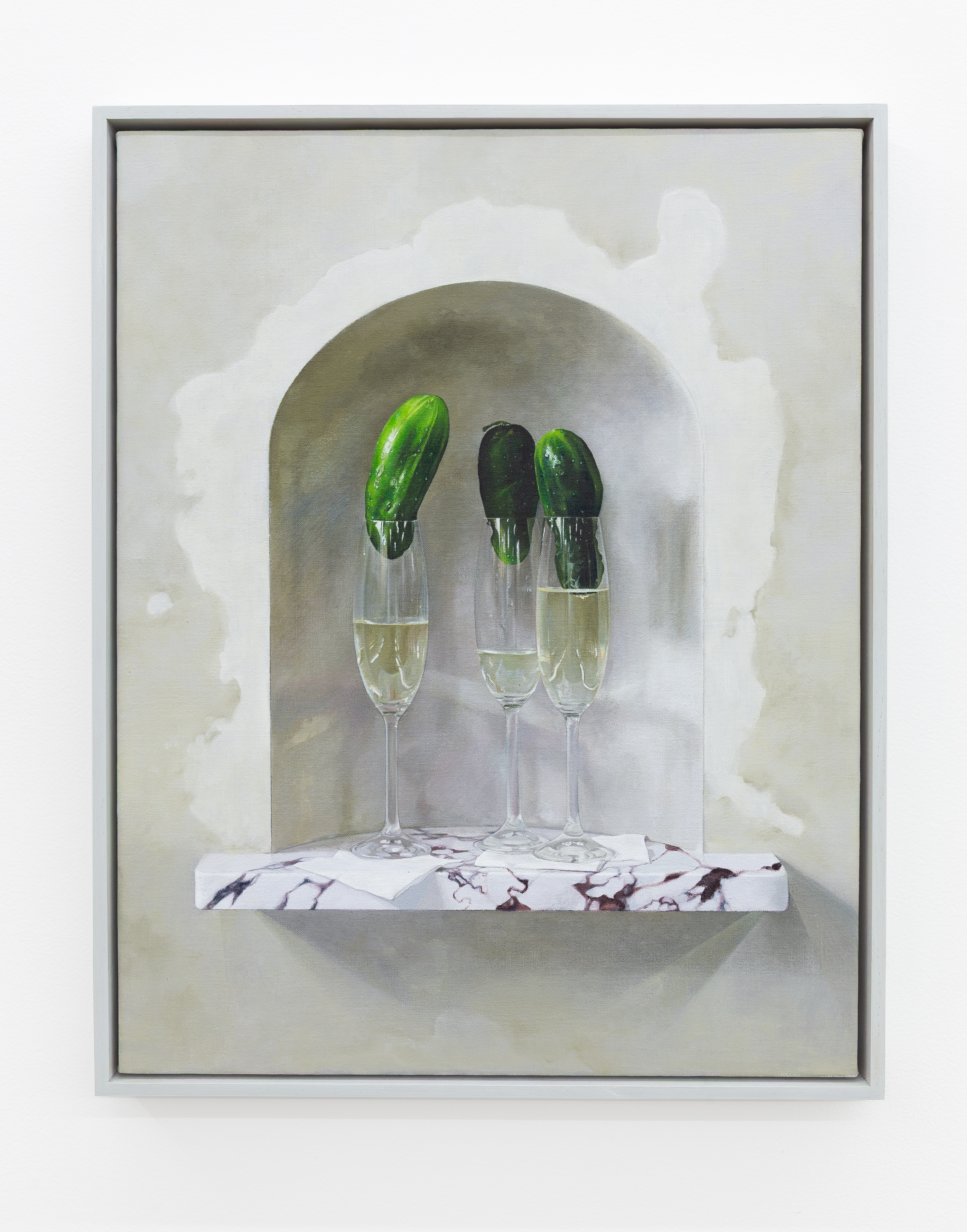
Tartaglia, Coviello and Pulcinella, 2025. 28 × 22 in (71.12 × 55.88 cm), 29 ½ × 23 ½ in (74.93 × 59.69 cm) (framed) Image Credit: Alivia Zivich
AC: Too strong...Is that a bad thing?
NS: Too strong in Italian, più forte, can also mean like too loud or political.
AC: I see, I mean, your work has always been sort of provocative.
NS: I was also kind of surprised. But I can understand that they don’t want to piss anybody off or put the church project into jeopardy.
AC: That makes sense.
NS: That experience inspired this series that is now on view in Basel. Basically, I built this niche based on a niche that exists in the church, partly to entice this particular director into scheduling an exhibition of my work, and naturally it became the prompt from which to develop these compositions.
AC: It’s like flirting a little bit.
NS: Right. So, I kind of wanted to have a couple of things that I thought would play to their particular set of interests. I ended up doing a photoshoot which resulted in 50 images, and we reduced it down to three.
AC: Wow, okay. And why did you choose these three?
NS: Well, the niche is a built thing, so that doesn’t change from image to image. And for the most part with these still-life images, I set up a camera in a static relationship to the niche, and then just start replacing things that fit onto this little shelf, improvising intuitively. I knew that there were some objects I was interested in. I’ve done a couple of other paintings with these small cucumbers. There have been other paintings with these champagne flutes, the holes were from a bow and arrow. The idea was to make a kind of absurdly trompe-l’œil image and have these arrows sticking out at you. We didn’t end up choosing one of those though. The broad theme was to kind of have this “end of the party” vibe.
AC: The cigarettes are in there, the glasses are half full yeah, yeah.
NS: Exactly. Yup. Drunk behavior. But, you know, the niche idea does extend back to a couple of different things. So, this painting titled Self Portrait in a Century (2021) is based on a corpse from the catacombs in Palermo. I superimposed myself and one of the bodies using Photoshop. It’s a reference to James Ensor; he did a double print of himself buried in the ground and a second one of just a skeleton in the same position. (James Ensor, My Portrait in 1960, 1888)
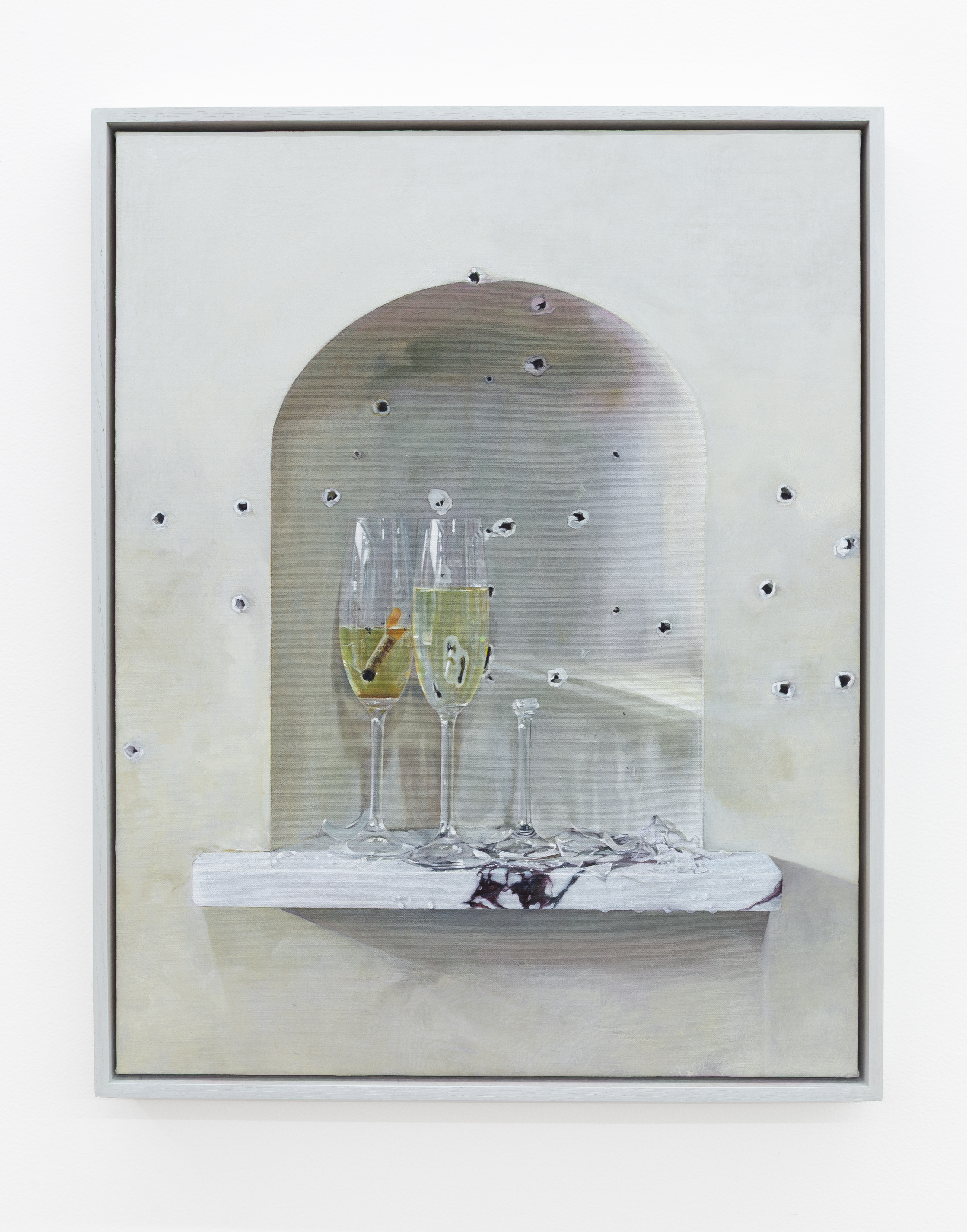
The Martyrdom of St Sebastian at the Grand Guignol, 2025. 28 × 22 in (71.12 × 55.88 cm), 29 ½ × 23 ½ in (74.93 × 59.69 cm) (framed) Image Credit: Alivia Zivich
The niche series also relates to the shallow cabinet still life compositions that are recurring in my work. I do one or two cabinets each year, mostly because they take so much time.
AC: Wow. And they’re big, right?
NS: They’re actual size.
AC: So obviously photography is a major part of your work. Are you the one who takes the photos, or do you hire a photographer?
NS: I have hired photographers in the past, but now I take most of the photos on my own.
AC: When did you start doing the sublimation stuff? That was 2018?
NS: Somewhere in there, yeah. Sublimation has helped me a lot to distribute labor across multiple people. When I was projecting something, only one person could work on the piece at a time. But with sublimation, we quickly press the images to the canvas and can give it to someone to start painting. It’s the equivalent of a preparatory sketch. Initially, the idea was to try to do some sort of combination of sublimation print and painting, but that never really happened. Occasionally you’ll see some residue of the print in the final works, but for the most part they’re getting completely covered.
In some cases, we’re basically taking a photograph and reproducing it very exactly. In other cases, we’re using the photo as a jumping off point and then kind of fooling around with the way that it gets painted.
AC: Throughout your work there’s always some weird blend between inanimate objects and the human body, and there are sexual undertones...Even in these niche paintings, even though they’re not figurative, they still are figurative.
NS: Yeah, they are kind of libidinal, you know. You asked me why I chose these three for the series — amongst the 50 images, there was this very clear progression because we we’re just swapping things out and playing with them. But these three stood out to me. I felt that they had their own internal narrative, so they can stand alone and feel like part of a progression of the idea at the same time.
Originally, we were playing with a bouquet of poppies, sticking them in the wine glasses and playing around with their placement. As we worked, we just kind of kept plucking them out and replacing them with other things until eventually this one poppy was left. I like it because it’s kind of shy, looking away from you. It has this kind of emotive energy without you really knowing what the logic is. I ended up calling that one Punch and Judy. All three of the paintings are named after puppet theaters, stemming from the idea that the niche is sort of like a stage, and the objects that are in the still lives are little puppets that are playing out of the scene.
AC: When you talk about art and the art world, it’s very evident that you’re aware of the movements throughout art history, but also the lore, like the narratives and allegories that surround artists throughout their lives.
NS: Yes, that stuff really gets my brain working, and lately, I’ve been pushing that interest further and further back into history. For instance, the exhibition in the fall was all about Duchamp’s Étant Donnés (1946-66), which is part of the permanent collection at the Philly Museum. It’s Duchamp’s final work, which took him 20 years to complete.
AC: It is such a strange and disturbing image.
NS: Deeply strange. It sort of makes you think of Courbet’s The Origin of the World.
AC: Yes.
NS: Because that one, too, looks to me like it’s not exactly anatomically correct. The way that the vulva sort of has this continuous line — that just always struck me as bizarre, throwing into question what you’re actually looking at.
AC: Yes and with Duchamp’s piece, it’s almost like part of the landscape, cavernous.
What I was saying about allegory and your relationship to art history…I was touching on your awareness and participation in conversations often prompted by Texte zur Kunst, your reference to Courbet just now demonstrates this, for instance…
NS: That’s true. The stories that I’ve been finding and the things that I’ve been really leaning into for the last two years have the same kind of energy. One of the things I’m just struggling to express, but really got me excited, was feeling like my friends and I, and everybody that we’re interested in, are doing this hyper meta thing, you know? Painting about painting. It has this kind of looping quality. But as I dive deeper into art history, I realize that that is what people have kind of always been doing. You can find it in Velasquez, DaVinci…Renaissance painters were already giving us these little hermeneutic things to decode.
AC: Yeah, definitely. And once you reach Modernism, then everything is sort of self-referential. Painting about painting…asking “how to do it?”
NS: Yeah. Asking “how do you take this thing apart and put it back together in a way that’s different but still legible to somebody else?”
One thing that I’ve been really obsessed about lately is this Leo Steinberg book called The Sexuality of Christ in Renaissance Art and in Modern Oblivion (1983). It’s a book about why we see Jesus in the nude, taking that initial question and looking at depictions of Christ throughout the Renaissance period. He showed the different ways that Christ’s sexuality, whether as an infant or as a grown man, is depicted, and why. Steinberg comes to some wild and interesting conclusions about the driving force behind the Renaissance.
AC: Mm-hmm.
NS: And he answers the question “Why do we see Mary pointing to Jesus’ penis?” in a lot of paintings. Even at the DIA there are paintings of this subject.
AC: Is it because they’re trying to emphasize that God was a man?
NS: Yes. This novel expression is based on the logic of the Christian relationship to God that Jesus was a real person. He wasn’t a ghost, he wasn’t a spirit, he’s not an angel, he is a flesh and blood person. That is something unique to the Christian religion.
AC: Oh, OK.
NS: And so, at a certain point, when the church shifts focus from trying to teach the public that Jesus was God, to teaching the public that God became man, right? His embodiment as a person becomes this thing that is very important, because God is just like you, you know?
AC: Helps God become more relatable.
NS: And in Steinberg’s mind, one of the major driving forces behind the Renaissance isn’t just the enlightenment and relationship to science. The reason that you see painters looking to Greece and Rome for these highly refined images and trying to bring that technology back is because, if you’re going to make a painting of Jesus as a man, then he has a certain length of hair. How long is his beard? How big is his nose? What do his fingernails look like? All these things suddenly become active questions. Where, in Pre-Renaissance painting, you’re getting more simplified caricatures of the figures.
AC: Like the Byzantine style?
NS: Yeah, sure. Byzantine style is a great example, where like, you know, you’re painting an icon basically. There’s a style to it, a kind of convention that painters were trying to be the best at enacting. You do see a lot of that kind of simplification, for instance, with Raphael. He’s early in the chain of Renaissance painting, and his style, while being highly refined, is still very stylized.
AC: That’s actually interesting when you look at Raphael, you see like the mother and child have almost the same face.
NS: But when you look at Antonello da Messina, a painter who made small devotional paintings, you find more realism in the figures. He made paintings of Jesus crying, and he has the crown of thorns on, you know. The thing about Antonello da Messina’s paintings is that you can tell he’s painting somebody. Like, he’s not just painting Jesus, he’s painting a real person he’s looking at, and using that person as a stand-in for Jesus. So, in his paintings, Jesus has a particular kind of eyes and a particular kind of mouth. Leonardo is another person who rides the line between stylized images and painting directly from life. Painters around this time start to flex their muscles by portraying the person they’re looking at.
You know, Holbein is a great example of this. In the midst of the Reformation, he was doing these highly refined paintings. And by the time you get somebody like Velázquez, who was mostly making paintings of the Spanish court, realist language was being used to create these complex allegories.
AC: And then what follows that?
NS: I mean you have the Mannerists and French painting that kind of takes over. Especially during the 16th and 17th centuries. You get Watteau and Fragonard who go back into this very stylized way of painting. They’re still painting the Kings, the Duchesses, but they all have this kind of soft-focus “beauty”. It is clear to me that this realist impulse has often been a minority impulse. It’s people who we really venerate, you know like Goya and Manet and Courbet and Velasquez, who were not really painting in the style that was the most common at the time.
Coming back to Duchamp or Courbet and those kinds of people, there is this kind of slightly punk interest in the real bodies people inhabit and trying to embed that into the work.
AC: Courbet is a painter that is often referenced by Isabelle Graw and other writers and artists surrounding TZK.
NS: And for good reason. I wasn’t a sophisticated enough viewer to really get this just by looking at the work, but the more I read about it, the more I understand that Courbet’s innovation is not just painting ordinary people. It was that Courbet is the first painter to put the audience in the position of the painter. So, when you sit in front of a Courbet work, you’re looking at it from where he looked at it, you know?
AC: How is that the case when like there’s so much portraiture where you’re viewing that world from where the painter was?
NS: Well, it is not necessarily that he’s like the only person to have ever done this, but he’s the person who makes it what his work is about. Prior to Courbet, and prior to this logic, you have this debate about the degree of theatricality of any given painting. So, if you look at a Jacques-Louis David painting, they are massive, like he’s basically like a filmmaker, right? He has a huge studio, every scene that you see is literally a theater set. So, there’s painted backdrops and objects that stand in for other objects. And he is doing the work to translate that into a reality that’s believable, right? And so, the point of this debate was to say, well, the real successful artists are the people who are able to make that translation so convincing that you forget that you’re there. Because the image that’s happening in front of you isn’t acknowledging you in any way. There is something about Courbet’s process of acknowledging the audience that makes his work stand out.
AC: Thank you for explaining that. I’ve read so many pieces about Courbet but was still left with so many questions about his work. Do you feel like this self-awareness that Courbet perpetuated through his work has inspired your approach to painting?
NS: I think that there is a degree to which I feel like the research end of things has helped me feel more confident seeing myself reflected in the past. I can see the reasoning behind certain impulses and instead of trying to be a painter making radical new things, there is actually something about this way of working that positions me as part of this lineage.
AC: You’re participating in a very long conversation.
NS: Yeah, and that conversation doesn’t just end in, like, 1968, you know? It goes back to, like, the 1420s.
AC: Do you feel like working in this way is somehow also a reaction to trends happening in contemporary painting?
NS: I have been working with these same interests and approaches since like 2013 or something. Back then, the amount of people who were really taking figurative paintings seriously was small. We went through this period where people were making paintings that looked like things, and maybe they were based on cartoons, maybe they’re not direct representations of something, but they’re kind of like these psychological collages or amalgamation of different influences and references — artists like Avery Singer or Jana Euler whose work is figurative — there was a discourse developing around a return to figuration.
Around 2015, I did an interview with Flash Art — it was me, Greg Parma Smith, and Jamian Juliano-Villani, and from that point I was like, I don’t actually feel like what I’m doing has anything to do with what these people are doing. But because each of our works involved the figure, that became sort of a catch-all term. For a long time now, I have been sitting with the thought, “What makes my work different from these two artists?”
I always knew I wanted there to be this kind of double language happening in my work that stemmed from a self-awareness and maybe a wry sense of humor as well. I want my work to speak to the art crowd while also resonating with civilians like my mom or my friends, you know, or like, somebody at the grocery store. I never wanted the work to seem like it was talking down to those people, you know?
AC: Or ignoring them.
NS: Yeah, even more important. I think that is an issue that is often levied against the Texte zur Kunst crowd.
AC: Yes, the writing can be super obscure and opaque. In a way, it’s protective.
NS: Yeah. I think that one of the things that the art world is lacking right now a little bit is a focus on that (theoretical) language. Obviously, those guys are still there and like, October still exists. The Whitney Independent Study Program is under threat right now, but you know, there are still people who understand and use theory. One of the things that has grown in popularity in the last ten years or so is the rise of identity politics, leading to a reduction in the philosophical and theoretical aspects of art.
AC: Identity politics comes with its own theory, which supports the work, but yes. And it can be difficult to find more philosophical approaches to art in a city like Detroit too, where identity politics takes the forefront.
NS: Yes, I am interested in talking about a much more philosophical take on art, rooted in continental philosophy. Of course, you still have Judith Butler where gender theory is involved, or Edward Said with an anti-imperial attitude, but it isn’t the only focus of their work.
When I entered the art world in the 2010s, the discourse was more about deconstruction and psychoanalysis and those are things I am still interested in. There was this balance between Lacan and Marx. Marx had the economy, and Lacan had the self, and those two things mashed together so you kind of got this full picture. I think that is part of the reason that you see this resurgence of Freud in recent years, counter to the overarching focus on identity politics fueled by boots on the ground protests and social theory.
Of course, there is something legitimate about highlighting underrepresented voices. This thought reminds me of that Dean Kissick article in The New Yorker saying that art sucks, the Biennial sucks, the Whitney sucks because they’re too focused on raising marginalized voices.
AC: Yes, along the line of Trump’s anti-DEI position.
NS: I don’t think that he would say it this way, but I think that it has this kind of Trumpy vibe. I think the problem that I have with that attitude is that he isn’t properly recognizing a fault in these major institutional exhibitions, and instead, is putting it at the feet of the wrong people. It’s saying like, “well this work sucks and it’s probably because the artists aren’t good, or because we’re obsessed with DEI or the idea of having Black or indigenous artists in the show”, instead of considering what it is about the current curatorial and institutional structures that make it impossible for them to do good shows. I don’t think it’s necessarily about artists not producing quality work.
I think that there’s a frustration in this group of right-wing, conservative downtown art people who feel hemmed in by having to use our language to talk about art. Because art has been so thoroughly defined by the left for so long that you can’t really talk about it in other ways without sounding just completely old-fashioned. I was reading a book about Manet’s marine paintings, paintings of boats, and the foreword is so conservative that it was basically saying nothing other than just describing the paintings. That might be the first stage of talking about an artwork, but basically, when you’re a conservative art writer, there isn’t a second stage, there isn’t more to talk about, you know?
AC: Yes, everything becomes very objective. Like how Hitler’s crusade to refine art through the preference for classical techniques. He inaugurated the Haus der Kunst in Munich the day before the opening of the Degenerate Art Show at the Institute of Archaeology in Munich.
Anyways, were we talking about that because I asked you about your response to contemporary painting…
NS: Yes, I was talking about how contemporary painters using figuration is something that just re-entered the scene, but I don’t really think that there is a robust critical language around it. There’s really nobody that I know of that’s writing about figurative painting in a way that is compelling. And I think that also a lot of different types of figurative painting are getting conflated into one type of painting, you know?
AC: Maybe that is why there are these issues with identity politics in art. It makes the work, and the artist, easily lumped together based on this surface quality, which limits the need for a language to be formed around these concerns as they relate to art making. A robust critical language may expand the work past that bubble of categorization, potentially even locating a more ambiguous zone where people of many different backgrounds can relate. But that zone would also result in work that is harder to talk about, harder to curate shows for, harder to understand without investing time and energy to understand. When work is easily categorizable, clear cut, it is easier to package for the public and doesn’t require too much work from the viewer.
NS: Yeah, maybe really what we’re doing here is solving Dean’s problem by saying that if we had access to a more critical and theoretical language, it might open things up and provide new ways to talk about art and identity that is more interesting.
AC: So, I guess, how can we sort of wrap this convo up? Is there a way like bringing it back to the paintings that you made for Basel?
NS: Um, gosh.
AC: We went through your interest in painting, your interest in painting about painting and your use of the figure, painting it the way you see it…
NS: Yes, there is something about those painterly conventions and this continuous process of re-challenging them. I think that really what it comes down to is that at each moment throughout history, there’s been somebody to step in and ask “How do we use images of other humans to reflect some embodied relationship to the changing environment?” Courbet, Manet, Monet, they’re all responding to this early industrialization in one way or another.
Our internet / social media era is in so many ways disembodying our interactions. It’s only showing an idealized snippet of reality, mediated by a piece of glass. I think by embedding images into an object, into a painting, there is a strange shift away from our fully virtualized selves.
AC: And what about the alloy-type quality of your images, combining different things together.
NS: I like to create a feeling like the kind you get when you have been invited to a party and you show up and there’s all these people doing something. They’re playing a game, having an orgy or whatever it is. They’re engaged in something that you don’t know the rules for. You don’t know how you’re supposed to participate, but you were invited, so you’re supposed to be there…the images are addressed directly to you, but you still don’t fully understand. This has been a fruitful way of working for me.
AC: You give the viewer a chance to rely on context clues, their own knowledge and experiences, and give into the fact that they will never really know for sure what it all means.
NS: And going back to the Courbet thing, so many of the images are tightly cropped. Similarly, I am literally putting your face inches away from somebody. I think that inviting the viewer to identify with this space that’s so close to something or someone enacts a kind of intimacy that can raise questions about comfort and desire.
AC: In a way you are using erotic desire to hint at just desire in general…
NS: I do. By using eroticism and desire in my work, I have developed this tendency to decenter my own position to make room for the potential desires and interests of the viewer. I have always been keen to question my own desires. When I talk to my therapist, she’ll ask “Why do you not know what you want?” I think that by being such a wishy-washy person with my own internal desiring mechanisms, the moments when I do feel these intuitive “yeses”, I know that that’s something that’s going to resonate with someone else. When I’m drawn into something in that way, it is a place where I can really open myself up to these what-if scenarios and allow myself to improvise.
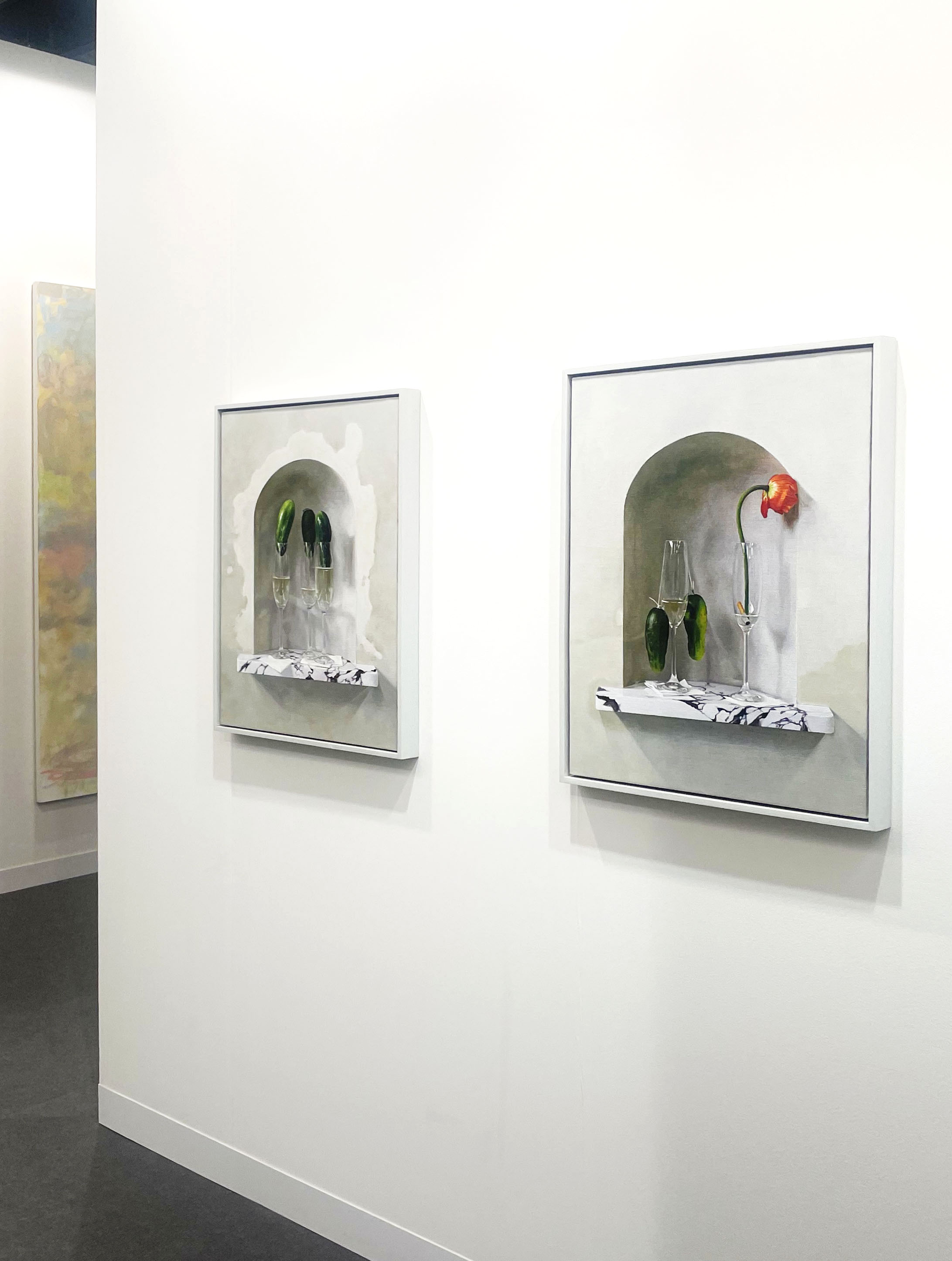
Installation image at Art Basel with 47 Canal, 2025 Image Credit: Oliver Newton