




Marissa Jezak
January 12, 2026
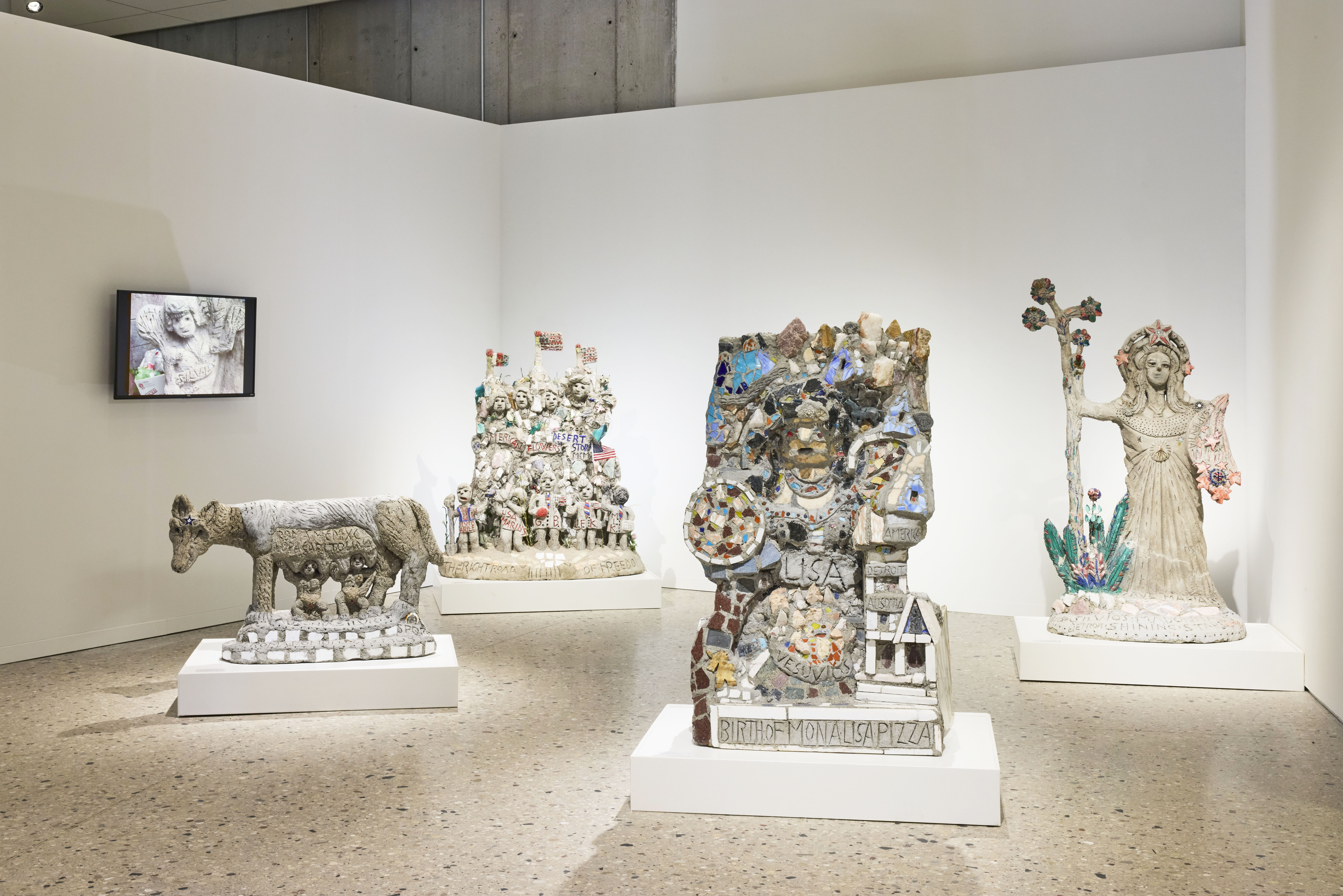
Installation view of works by Silvio Barile at the Art Preserve, 2025. John Michael Kohler Arts Center Collection, gift of Kohler Foundation Inc. Photo courtesy of John Michael Kohler Arts Center.
Tucked away in the calm natural habitat of Sheboygan, Wisconsin, the Art Preserve of the John Michael Kohler Arts Center stands out proudly, towering high above the ground with a sleek, contemporary architectural facade. Even with prior knowledge, one could not predict the grandiosity and awe when encountering the massive treasure trove of artworks housed inside. Sculptures, paintings, assemblages, and even entire houses are on display throughout the multiple floors of this impressive collection of folk art, many acquired from local artists who have since passed on, providing a permanent resting home for their collections and legacies. Notably, there is a gallery devoted to the psychedelic drawings and iconic chicken bone towers of Eugene von Bruenchenhein, as well as a whole section on the top floor full of Nek Chand’s rock people, each one carefully adorned with dozens of mosaic fragments to illustrate their clothing and distinguishing personal features. Temporarily featured among the remarkable collection at the Preserve are a small selection of sculptures from Silvio Barile, a late artist and former Michigander who originally immigrated to the United States from Italy.
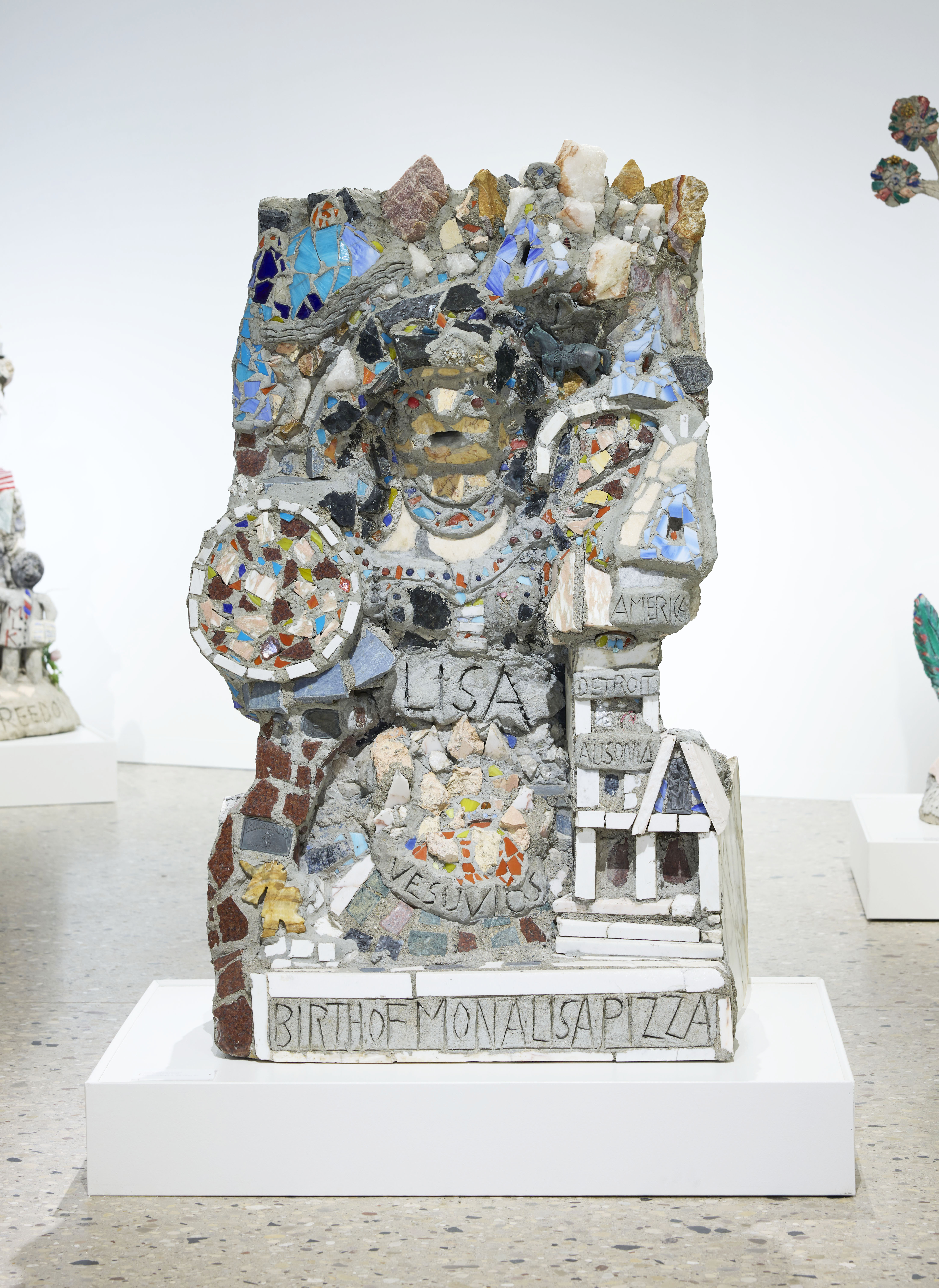
Silvio Barile, Birth of Mona Lisa Pizza, n.d.; concrete; 46 x 38 x 18 in. John Michael Kohler Arts Center Collection, gift of Kohler Foundation Inc. Photo courtesy of John Michael Kohler Arts Center.
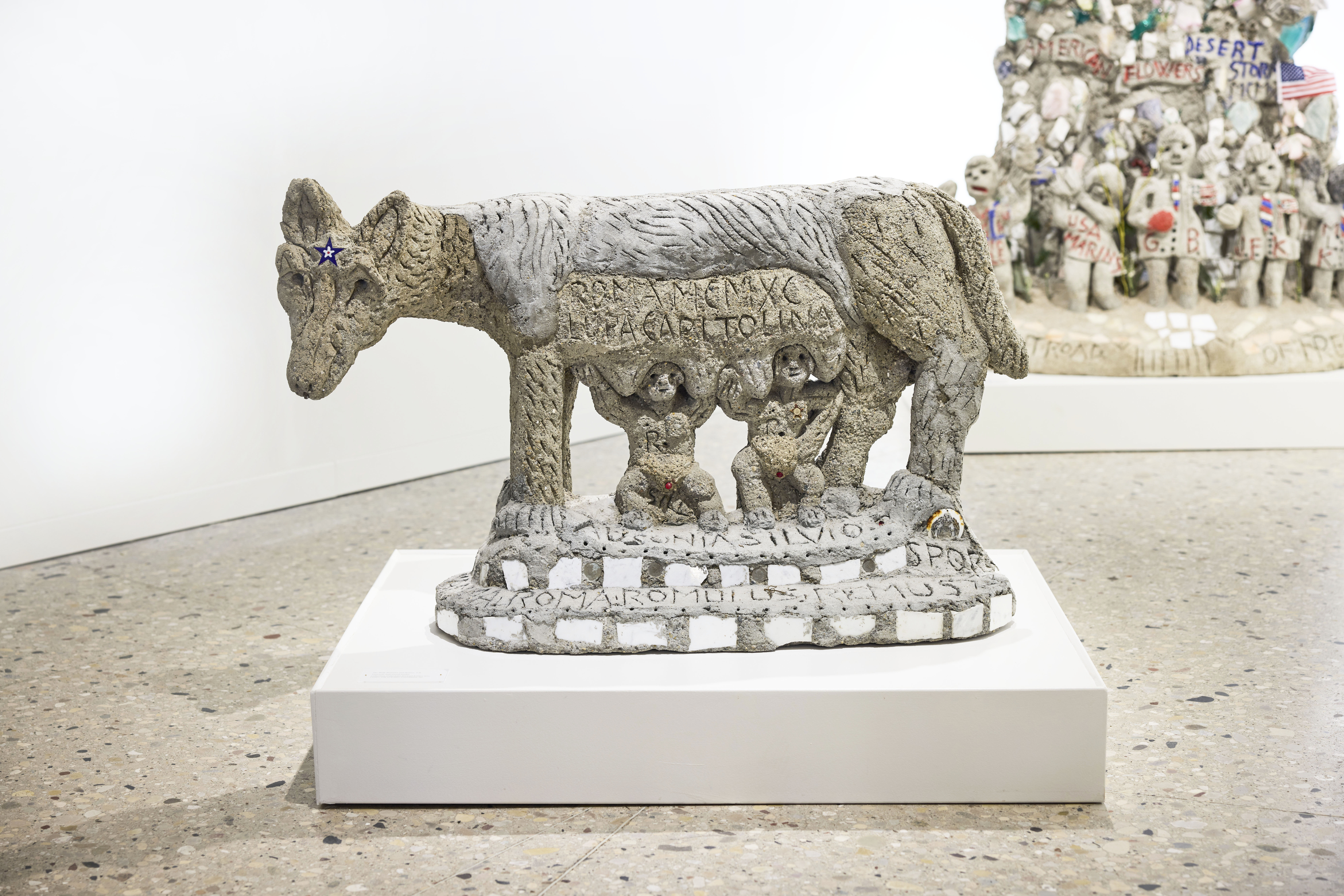
Silvio Barile, She Wolf Romulus and Remis, n.d.; concrete; 24 x 48 x 12 in. John Michael Kohler Arts Center Collection, gift of Kohler Foundation Inc. Photo courtesy of John Michael Kohler Arts Center.
Previously, Barile operated a pizzeria in Redford, Michigan, which he elaborately decorated with his own sculptures, statues, and ephemera honoring his Italian heritage. His urge to express through these painted cement forms was so intense that his works filled the restaurant, and the space surrounding it for an entire acre behind the building. When the pizza-making came to an end, the artworks remained, as Barile had made a name for himself as more than a maker of pies, but a loved and respected artist and an important proponent of his community. Sadly, the site was destroyed in 2020; the Art Preserve has since acquired all the known remaining works from the site—eleven large sculptures in total.1
Made of casted and sculpted cement that has been painted, carved into, and embedded with mosaic tiles and stones of diverse dazzling colors, the four works on display each have a distinct affect, and focus on different historical figures. Words are carved into them, denoting places, people, and icons, providing context to aid interpretation. In the undated Birth of Mona Lisa Pizza, a conglomerate rectangular rock formation filled with different colored rocks and clusters of mosaic tile almost serves to conceal the womanlike form hidden within its center. The title is written clearly at the bottom, with the words “Lisa”, “Vesuvios”, “America”, “Detroit”, and “Ausonia” carved throughout the composition. The rocks appear like a crown of crystals above the head; her face sitting recessed among the detailed assemblage of colorful tile.
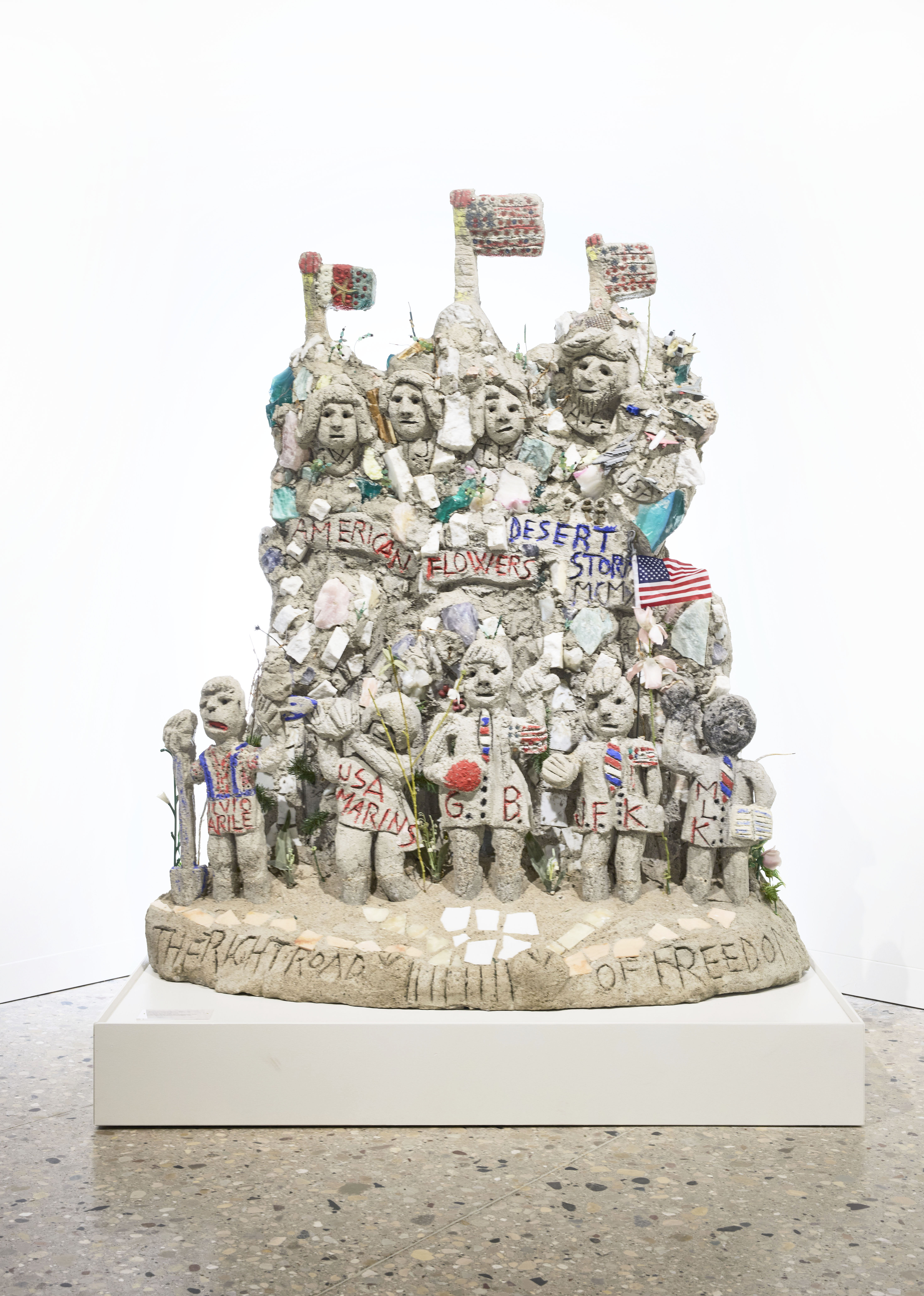
Silvio Barile, American Flowers Desert Storm, n.d.; concrete; 60 x 48 x 24 in. John Michael Kohler Arts Center Collection, gift of Kohler Foundation Inc. Photo courtesy of John Michael Kohler Arts Center.
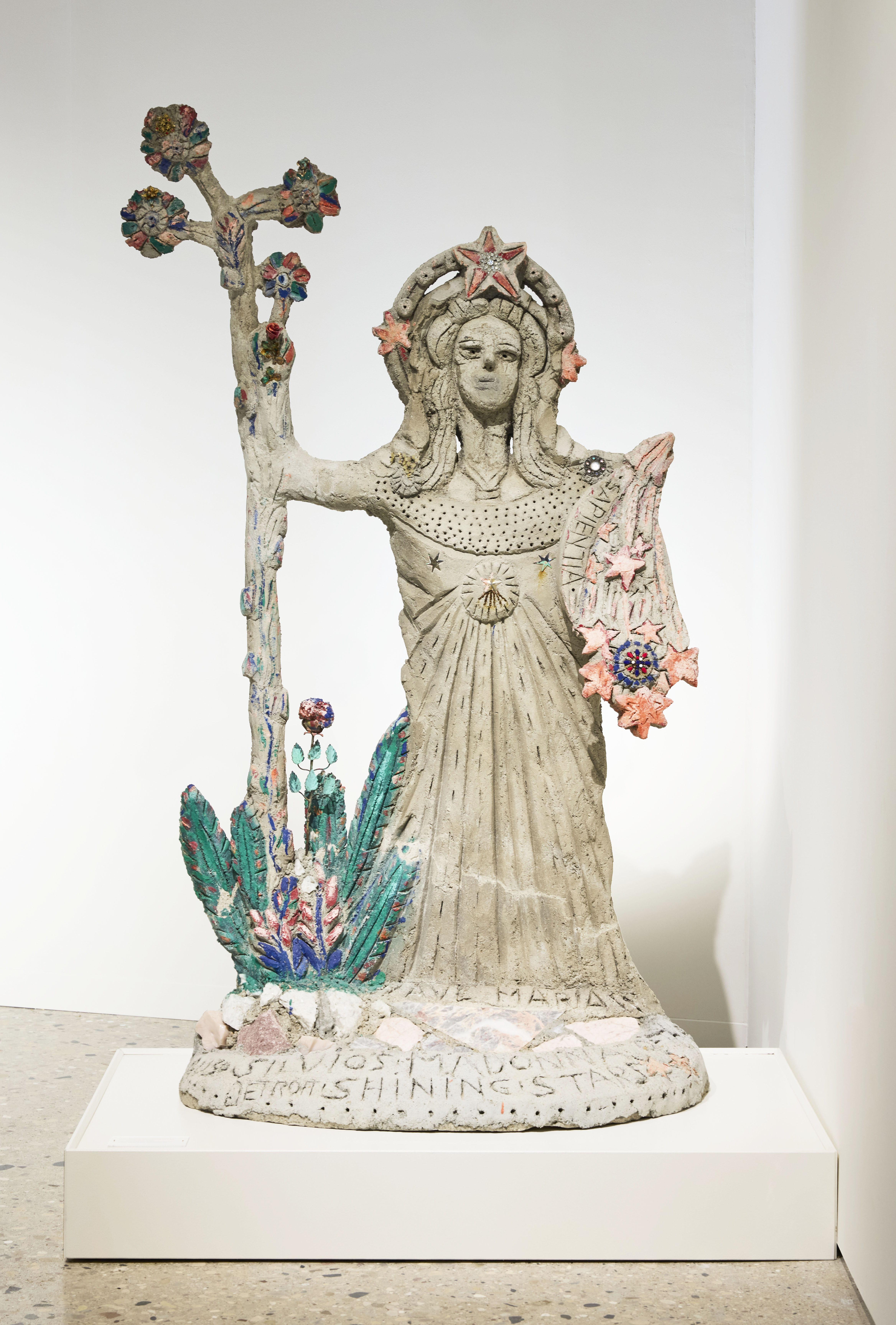
Silvio Barile, Silvio’s Madonna Detroit Shining Stars, n.d.; concrete; 60 x 48 x 16 in. John Michael Kohler Arts Center Collection, gift of Kohler Foundation Inc. Photo courtesy of John Michael Kohler Arts Center.
Another piece, American Flowers Desert Storm has a more patriotic feel, bearing a resemblance to Mount Rushmore, and featuring American flags, and labeled people such as J.F.K, M.L.K, and even the artist himself. The words “the right road of freedom” line the base of the work, perhaps a commentary on the artist’s political beliefs, reflecting an optimistic outlook on life in a new country, “the land of the free”. Interestingly, the soldier, artist, and activists stand at the trunk of the work, functioning as its support, while the historical leaders’ floating heads look out from above.
One may draw the comparison of Barile’s statues to some of the cement works by Adolphe-Julien Fouéré (France) and Filippo Bentivegna (Sicily)2, where elaborate bodies are sculpted in a way that makes them unavoidably interconnected with one another, essentially becoming their environment. However, there is a sense of materiality and an immediacy that can be identified as particular to the cultural and regional setting in which the works by Barile were composed, that is undoubtedly Midwestern, and at the same time, proudly Italian American. Thankfully, the Preserve has expertly curated the presentation of objects and environments surrounding Barile’s statues so as to perfectly contextualize them within a neighborly cultural atmosphere. The collection seems to thoughtfully recognize the similarities in medium, content, and socioeconomic origins of its artists as part of a more nuanced study on folk art of the American Midwest and beyond. In their words: “acknowledging that this phenomenon of making did not happen in isolation but was influenced by the regional customs and the makers’ proximity to and influences on each other.”3 In a sense, one may look at the works of Silvio Barile as part of a collective process—utilizing techniques and a materiality shared by other artists in the region, maybe it’s just taking them a while to all finally be seen together.
1. John Michael Kohler Arts Center, “Silvio Barile,” jmkac.org, accessed Dec. 17, 2025, Link.
2. Colin Rhodes, Outsider Art (World of Art), (London: Thames & Hudson Ltd., 2000) 190-191.
3. John Michael Kohler Arts Center, “First Floor,” jmkac.org, accessed Dec. 17, 2025, Link.